Showing posts with label Access Transit. Show all posts

Sunday, June 3, 2012

Save the TaxiSavers

One news story that has been making the rounds recently is TransLink's cancellation of the TaxiSaver program.

For those who do not know what it is, the TaxiSaver program is designed for people with disabilities who are eligible for HandyDart, Metro Vancouver's para-transit service. TaxiSaver is supposed to complement that service for instances where HandyDart is not an option, such as for last-minute or unplanned trips, by subsidizing 50% of the cost of a cab fare.

Even though I do not use HandyDart or TaxiSaver myself, I know some people who do. It did not surprise me one bit when the news was met with outrage.

One of the biggest issues facing people with disabilities who take public transit is planning. Able-bodied people can "hop on" and "hop off" whenever they want, but people with disabilities have to consider multiple factors:

  • How accessible are the bus stops? (In the City of Vancouver, over 50% of the bus stops outside the downtown core are not designated as accessible.)
  • How accessible is the destination? Is there an accessible place to get off the bus?
  • Do the vehicles' accessibility features work for the destination? (ie. A ramp/lift may not work well for a rural road or roads without sidewalks.)
  • Are the bus stops on a slope? Can a wheelchair user handle that slope?
  • For people with other conditions (such as vision impairments), are there dangers around the bus stops that the person may not be aware of?
  • etc.

As you can see, it is not a simple procedure. This is where HandyDart would usually come in, because they would have specialized service that would drop off the passenger at a safe spot.

However, there are major shortcomings of HandyDart:

  • Trips must be booked well in advance: at least 24 hours and sometimes up to a week.*
  • Trips make multiple stops and detours throughout a city to pick up other passengers. It is not unheard of for a simple one-way trip to take hours.
  • Despite the duration, regular adult fares apply for the trip (while concession fares can be used for trips using conventional transit).
  • Trips operate on strict schedules. If you miss your outbound or return trip, you missed it. It is not as simple as "waiting for the next one."*

I italicized several points because those are the most important ones.

TaxiSaver's major advantage is countering HandyDart's required advanced booking. Unlike HandyDart, TaxiSaver does NOT require a booking well in advance. It allows for spontaneous last-minute trips. This is especially important for people who may be called in to work at the last minute, people whose doctor just opened up a last-minute appointment and younger people with disabilities who have active social lives. Without TaxiSaver, many of these people would not be able to make it to their workplace, doctor's offices or friends' gatherings.

The other major advantage is not having to adhere to a strict schedule. How many times have you gone to a mall and found something cool and need to spend some unexpected time to take a look at it? Or how many times has something happened (ie. you lost your wallet) and need to spend extra time to resolve the situation? HandyDart's strict schedule does not allow for this kind of flexibility, and once the ride is gone, it is gone. It is not like a bus, where you can wait for the next trip. TaxiSaver would allow for things like these, and allow someone to find his/her way home even if the HandyDart ride is gone.

One of TransLink's reasons for eliminating the TaxiSaver is that the fleet is now accessible, unlike a decade ago.

However, they are forgetting the very fact that HandyDart (and, in turn, TaxiSaver) exists. The service exists for those who cannot take conventional transit without assistance due to age or disability. Therefore, if a last-minute trip is needed, then you are effectively "throwing the person to the wolves," so to speak.

It is not a secret that many of TransLink's routes are overcrowded. For someone with a disability, that is a near insurmountable challenge. If a person with a disability is "thrown to the wolves," he/she may be jostled (especially startling if you are blind), there may not even be space for someone to get on (especially for wheelchair users who cannot "squeeze on" like able-bodied people), there may be too much noise around to pick out individual noises like stop announcements (bad for those who have hearing or visual impairments) and so on.

Imagine if you fit into one of those examples I just listed. How would YOU cope on conventional public transit, if you were forced to?

You probably would not cope well at all.

Over time, the bad experiences may pile up and you may decide to simply stay home instead of joining your friends.

You may decide to say "no" to your boss wanting you to come in for a last-minute shift. This may cost you your job.

You may not be able to go to a last-minute doctor's appointment, and continue to suffer from an illness, an injury or pain.

Is it not obvious, then, why getting rid of the TaxiSaver program would be catastrophically bad?

(Ironically enough, TaxiSaver costs TransLink less to run per trip than HandyDart; in other words, TaxiSaver is MORE cost-efficient than HandyDart!)

This is yet another situation where it is obvious that people without disabilities are automatically assuming that they know what is best for people with disabilities without any knowledge of the issues that they face. It makes me wonder why people without disabilities are often put in charge of many services for people with disabilities. The outcry in response to the TaxiSaver's proposed cancellation is proof of a situation where those without disabilities simply "don't get it" sometimes.

Thursday, October 6, 2011

No room to spare

Did you know that TransLink offers all people a chance to test out whether their wheelchair, scooter or other mobility device will fit on board a bus?

Before my first time on board a bus in my wheelchair, I had never tested it out. I am fortunate to have a relatively compact and sleek wheelchair that can squeeze through many small spaces, but not everyone has one. If you are in doubt about whether your mobility device can get on the bus, it might be a good idea to take advantage of TransLink's offer to test it out on a not-in-service bus first.

Otherwise, something like this could happen:

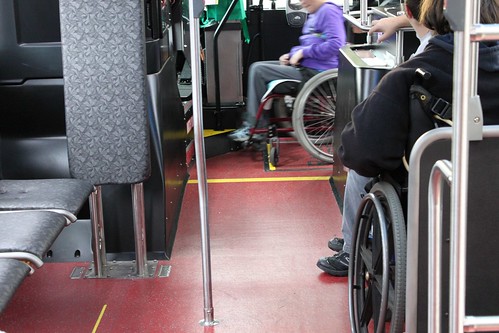
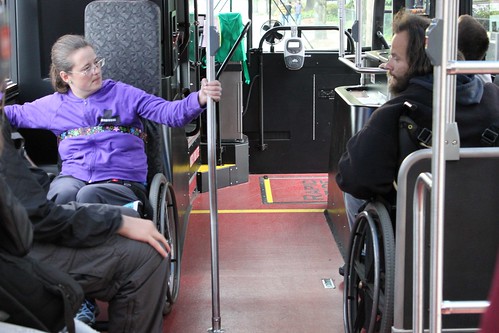
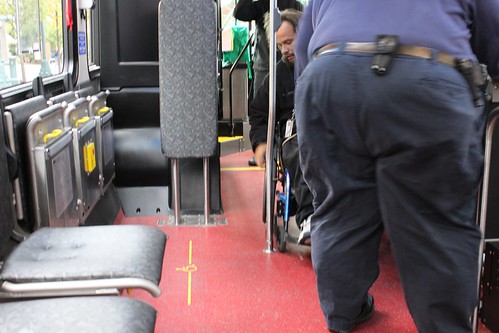
(Photos from Oran Viriyincy at Flickr, taken near Seattle, WA)

Does not fit
Does not fit: Because of the people sitting on the right side, this man in a wheelchair can not go around the stanchion to use the passive restraint (his first choice). He ended up using the traditional straps.

Still does not fit
Still does not fit: the lady in the wheelchair can not go around the stanchion to use the passive restraint because there isn't enough room to maneuver around it. She, with assistance, boarded through the middle door to get to the passive restraint position.

Two wheelchairs on the B Line
Two wheelchairs on the B Line: One passive restraint (boarded through middle door with assistance, no ramp), One forward facing position (through front door ramp).

Whew! That took a long time. Speaking as a wheelchair user, I hate delaying other people's commutes and my own for something as simple as getting on or off a bus.

TransLink's buses are pretty good when it comes to accessibility, but one bus that makes the above situation unlikely is the Nova Buses (the ones with the double doors at the front). Those buses get a lot of grief from able-bodied riders but in terms of accessibility, they are wonderful – wider front entrance, front wheel moved back (making it less of an obstruction), plenty of space to maneuver in the front and so on.

However, that doesn't mean that anyone can manage those buses on the first try. If you have any concerns or doubts about getting on or off with a mobility device, take advantage of TransLink and Coast Mountain Bus Company's offer and test it out at their depot. More information is found here (look for "Travel Training").

Monday, August 8, 2011

Bus Stop Hop 2011: Bring your best wheels. Wear comfortable shoes.

Yesterday was the 10th annual Bus Stop Hop. For those who don't know what it is, it is an event hosted by the British Columbia Paraplegic Association in partnership with TransLink. In short, it is similar to "The Amazing Race" where you try to hit certain locations and find certain objects/facts faster the teams competing against you.

The twist to this? You must use public transit to reach those places. This includes the bus, SkyTrain, SeaBus and Aquabus. There were fifteen teams and each team consisted of two able-bodied participants and two participants with mobility impairments. My team had one absentee, so we had someone from TransLink (who was originally there to shadow us and take photos) become our unofficial fourth member. The two rolling people on my team consisted of one manual wheelchair user (yours truly) and one power wheelchair user.

It was my first time at the event and it was cool to meet so many new people, and to come across those I've met before -- definitely one of the better networking events I've come across. This year's event was apparently the largest one ever in its ten years of existence.

The day started and ended at Performance Works on Granville Island, and the locations that were required were Vancouver International Airport, the bus cloverleaf on Granville Street at West 5th Avenue, Lonsdale Quay and Science World. At each location, you must obtain a fact and write it down, get a signature from a staff member there, or complete a task.

In addition, there was a trivia sheet that each group completes for points, as well as extra tasks for bonus points. This means that even if a team came in first in terms of time, they can still slip to second or third place because of points.

Each team had their own strategy. It seemed like the majority of them decided to start inward and move outward -- in other words, start at Granville Island and move farther and farther before reaching Vancouver International Airport (the furthest destination). After all, Granville Island had the most tasks and bonus points in the race so many seemed to decide to get them out of the way first.

...which probably meant chaos at the same locations. So our team decided to do almost the opposite -- start farthest away and move inwards to the final destination.

Our idea:
  • Go to the 5th Avenue bus loop: [first location]
  • From there, catch the 50 False Creek South bus to the Canada Line.
  • Take the Canada Line to Vancouver International Airport: [second location]
  • Take the Canada Line to Waterfront Station.
  • Take the SeaBus to Lonsdale Quay: [third location]
  • Take the SeaBus back to Waterfront Station.
  • Take the SkyTrain to Science World: [fourth location]
  • Take the Aquabus from Science World to Granville Island: [fifth location] *
  • Complete all the Granville Island bonus tasks.
* Remember this step. You'll see why later.

In short, our routing was planned to look like this:

View Bus Stop Hop route 1 in a larger map

We had it all planned out. So while everyone else tackled locations closer to home, we set out for the 5th Avenue bus stop.

And then my wheelchair decided to malfunction.

What happened was that my footplate's bolts were loosening up and the footplate slid to the point where it was scraping the ground. It was kind of dire for a few moments as we went up the hill adjacent and below the Granville Street Bridge. Somehow, we made it and as the task at the stop was bring handed off to my partner, I took the time to make a pit stop repair; thankfully my partner had a tool kit handy (lesson learned; I'm going to the hardware store tomorrow).

---
EDIT: Access Eco BC blog has a photo of the wheelchair malfunction. My "greatest" moment captured on camera!
---

We were the first team to that location and we had luck on our side at the start. We did not have to wait for more than a few minutes for any of the buses or SeaBuses until our return from Lonsdale Quay.

At the airport, we finally ran into some of the other teams. But we were confident; we were certain that nobody else had the 5th Avenue bus loop yet, so we were probably one stop "ahead" of the others. We completely blazed through all of the locations until after Lonsdale Quay, when we narrowly missed a SeaBus by a couple of minutes, resulting in a 15-minute wait for the next trip. Our momentum hit a snag.

Our next stop was Science World, which was conveniently under renovation. There was a bit of confusion as the lady at the information desk was not told about the Bus Stop Hop; this lapse allowed some of the other teams to catch up in the meantime.

After that, we thought we were home free -- one more Aquabus ride back to Granville Island to complete the final tasks, and that was it!

Or so we thought.

Because, you see, this is 2011. This is the digital age. That means unless something has "LOL" or "OMG" in it, we are not likely to read it.

We completely missed the tidbit in the instructions saying that the Aquabus was only running accessible services between Granville Island and... David Lam Park. From Science World, taking transit to David Lam Park was difficult if not nearly impossible on a Sunday schedule with two wheelchair users at the same time.

So we decided to hike it.

My partner kicked his power chair into high gear and I went into my wheelchair racing mindset. Our TransLink staff member had to leave after Science World, so our lone able-bodied team member had to jog it -- in her sandals/flip-flops.

It was no short trip by any means and she had to actually run to keep up with the team's high-speed power wheelchair user and rabid (though occasional) wheelchair racer. I have no idea how she did it, but she survived all the way to David Lam Park. (I had to hold on to my power wheelchair partner for a lift for about 10% of the way, so it was quite insane.)

So eventually THIS became our route (pay attention to the False Creek area):

View Bus Stop Hop route 2 in a larger map

After accomplishing the tasks there, we arrived back at base camp on Granville Island, answered the trivia questions and sent our stuff in. Third place! (We later slipped out of that position due to points, but anyways... THIRD PLACE!!! -- in our deluded little minds where leprechauns rule the Earth.)

All in all, it was pretty fun. Just waiting for the aches to kick in from yesterday's wheeling sprint from Science World to Yaletown. It hasn't happened yet but it probably will in a bit, which should be awesome.

Random post-blog thought:

(Next year, maybe have a friend stand by at Science World with a racing wheelchair. Fool me once, shame on you. Fool me twice...)

Thursday, June 9, 2011

Access Awareness Day, bus stop accessibility

This is almost a double-post; the first part will talk about Access Awareness Day, after which I will segway into accessibility of bus stops.

This past Saturday, June 4 was TransLink's Access Awareness Day. Unfortunately I was unable to attend the festivities on Saturday due to a sledge hockey lesson (in which I managed to destroy part of the ice by digging a 2-cm rut into it -- oops!) but on Wednesday there was an event at Metrotown that I was able to attend.

For those who missed it, it was basically an event that focused on accessibility awareness. It was a day that provided the opportunity to able-bodied people to experience what it is like to use a public transit vehicle with a mobility aid; a scooter and a manual wheelchair were available for those who wanted to try.

So naturally, I had to drag my friend to the event to torture him a little. He was lucky that the bus on hand was a NovaBus, which has a better layout than other buses like the New Flyers. Even so, it was interesting to see how long it took him to get on and off the bus, without hitting anything. TransLink also took along an empty baby stroller to use to demonstrate real life situations -- so not hitting anything is a major key here, unless you want to end up with an injured (albeit imaginary) baby!

While it was an informative day for those with no experience using a wheelchair, I learned something new as well -- trying to navigate on board using a scooter. I had tried power wheelchairs before but never a scooter. Surprisingly, I did not hit a single thing getting on or off the bus. Skills, dudes. Skills!

After meeting some TransLink and Coast Mountain Bus Company personnel such as Jim (from transition and quality assurance) and Andrea (a training instructor from Vancouver Transit Centre), I got to meet Robert, who currently runs The Buzzer Blog. He got a long jealous stare from me, as he currently has one of my dream jobs. (Sorry, Robert!)

One thing that I wish I had joined earlier was the Access Transit committee of TransLink. Why I never joined is beyond me, but it's interesting to see who is advocating for what in our public transit system as well as what kind of improvements (and "whoopsie"s) have been made or are in the works. For those who are interested in this sort of thing, it's definitely something that's worth looking into.

One of the things that entered the discussion is the fact that while the bus fleet and TransLink-owned infrastructure have been made more accessible in recent years, there are still some nagging issues such as accessible bus stops.

Some examples of bus stop problems are narrow sidewalks (without adequate room for deploying ramps) and locations of bus stops (it may be surrounded by hazards for those with mobility impairments). There are more examples but those are the biggest ones.

Having a committee of transit riders with mobility impairments helps drastically because there are things that nobody else would think about. Here are some real-life examples I've encountered:

West 49th Avenue [eastbound] at Montgomery Street, Vancouver
The bus stop is fine. It has tons of room, it is on a manageable slope, it is clear of a lot of hazards. However, it is "stranded" -- there are no curb cuts for the sidewalk leading to the stop itself. Thus, it remains inaccessible no matter what TransLink does.

King Edward Avenue [westbound] at Marguerite Street, Vancouver
The bus stop is deemed "accessible" but a tree blocks access to the bus shelter. The other end is clear but it requires that you wheel through the dirt. (This stop may have been fixed since then.)

West Broadway [eastbound] at Macdonald Street, Vancouver
This stop is a bit of a sore spot, especially since it serves the busy 99 B-Line. It is accessible but only if the driver knows the trick to it (and as a passenger, sometimes it is necessary to tell the driver what the trick is). For it to work, the driver must line up the front door so it doesn't result in the wheelchair user either crashing into the bus shelter or the nearby tree -- there is a small gap between the two that I usually squeeze through. That gap is not too big and I'd imagine for people with larger power wheelchairs or scooters, they'd need to get off a few metres ahead of the stop.

Railway Avenue [southbound], Richmond
This one baffles me. Northbound is fine because there is a sidewalk, but there is no sidewalk or anything of the sort going southbound. This is something the City of Richmond may need to figure out, because trying to get off the bus in a wheelchair along that stretch is a bit of a thrill ride.

West 49th Avenue [both ways] at West Boulevard, Vancouver
If you are heading to this stop from the east or the north, it's no big deal. But if you're heading in from the west or the south, then it's a chore because that's the only nearby accessible stop -- and it requires you to push your way uphill. Terrain, while not a big deal to most people, can be an obstacle to those who use manual wheelchairs (such as myself) or other manual mobility aids. Basically, you will need to exert a huge amount of energy to use one bus stop even if there's another one five feet away. A lot of this has to do with the sidewalks being too narrow; hopefully there's a solution to this.

I think I'm done ranting. Those are only several examples I've seen. Notice how none of these are rural examples but rather urban and suburban ones. I think when people start to look carefully at these little things, Vancouver can be made even more accessible than it is right now; this city has made huge strides but its job is far from being done and nobody should feel completely satisfied at the present situation just yet.

It's very likely that I'm going to look into getting involved with the Access Transit committee; let's see if we can get the ball rolling on making the system welcoming for everyone.