
It has been a long time coming but TransLink is launching a large-scale construction project involving faregates at all SkyTrain, SeaBus and West Coast Express stations. It is hoped that by abandoning the old fare paid zone "honor system," the system will attract fewer fare evaders as well as provide a feeling of security and safety on board. Also, it will integrate the new reloadable transit card ("Compass" card).
Construction is already underway at several stations. As with most new projects, TransLink is offering some information to the public about what is happening. Many people in Metro Vancouver have experienced faregate systems before; others have not.
I have had the pleasure of experiencing faregate systems in eight different cities around the world. I'm guessing that is more than the average person.
Of course, the biggest concerns I have with faregates are accessibility-related. Until recently, my concerns about TransLink's faregate accessibility were present but they were fairly minimal. But that changed the other night when I was discussing accessibility with faregates with someone online who is somewhat of an expert on public transit issues.
When stating my concerns about accessibility, the reaction from that person was, "All they need to do is widen the faregates for wheelchairs/scooters."
While that is true, it is not completely true – widening something is not all it takes to make something accessible.
That was when I realized that if someone who is so well-versed in public transit issues thinks that, then there is a chance that TransLink officials will think along the same lines.
I've been concerned about the lack of prototypes. When TransLink or Coast Mountain Bus Company introduces a new vehicle, they tend to show off a prototype before the full-scale launch. I have seen nothing of the type for faregates (and I was told that prototypes are not available yet).
At the presentation at Edmonds Station the other night, the artist's depiction of the faregates confirmed some of my concerns (though I am aware it will not be exactly as shown) and the representative I talked to did not seem to foresee some of the accessibility issues that I did.
So what does it take to make the faregates accessible?
1. Wider pathways: This was already discussed and confirmed. However, this is only the beginning.
2. Lowered displays and card-swipe area: Height is surprisingly the most overlooked aspect of accessibility, not only for transit but also for things like washrooms (where towel dispensers are often too high for people in wheelchairs to reach).
I once encountered a faregate system that was quite efficient. However, one sore spot they had was that the digital display (showing how much money was charged to your card and how much is left) faced the ceiling. For a standing person, that is fine. But for a person in a wheelchair, this is useless; how can you see a display at your eye level that is facing the ceiling?
In addition, if the card swipe pad is at the top of the faregate (a.k.a. wheelchair users' eye levels), it is nearly impossible to see WHERE we are supposed to swipe. In addition, those with limited hand and shoulder function (such as partial quadriplegics, those with cerebral palsy, etc.) will not be able to reach high enough to use their transit cards.
This is a VERY important feature that should be looked at carefully. The cities I've seen that have done it right had lowered swipe and displays, approximately 3 feet from the ground, in addition to "normal" standing-level swipe and displays.
3. Depth of card swipe area: One mistake I've seen is some cities with such "touchless" transit cards have swipe areas that are indented INWARDS towards the machine. In other words, the swipe area is in a 1-inch "sinkhole" into the machine itself. This can cause some problems for those with limited hand function.
Some cities have rectified this by doing the opposite: having the swipe area jut OUTWARDS instead. This is a very simple solution that would also work for those with limited vision -- they can feel around for the part that is jutting outwards and swipe their cards that way.
4. Audio cues: This is mostly for those with limited vision and I am sure TransLink will consider this. Some cities I have seen will play a sound clip reading out how much money is left in the card and how much has been subtracted.
5. Another possibility (perhaps a bit far-fetched): For those who use power wheelchairs and have almost no use of their hands, many choose to wear their transit passes around their neck. While bus drivers and transit police will be able to see the pass, a machine will not. I have never seen this solution before -- but perhaps a proximity reader is possible for this situation. For example, once you get 1 foot within the faregate, it will read the card.
I honestly do not know if this is possible but it might be something to think about. Perhaps the technology is available already; if not, I could see a local organization spearheading this.
Showing posts with label SeaBus. Show all posts
Showing posts with label SeaBus. Show all posts
Friday, December 2, 2011

Monday, November 7, 2011
Location, location
The other day, I was leaving GF Strong Rehab Centre in Vancouver and headed to the bus stop. When I got there, there were a few people waiting. Among them was a woman with her daughter, who was in a wheelchair like me. We were both waiting for the 25 bus.
Those who know the 25 bus don't need to be told how packed, off-schedule and chaotic that route can get. As the bus approached the stop, I looked and saw that it was jam packed. The girl, her mother and I quickly had a verbal plan about how to board the bus. I was going to take the forward-facing spot while she would take the backwards-facing spot. It seemed simple enough.
Of course, it was the 25 bus.
What happened afterwards could only be described as absolute chaos. I knew exactly what to do and where to go. The other passengers, however, didn't. Words can not describe how frustrating it was to repeat, "I need those seats over there" while other people just stood there and stared and the people in the seats I was pointing to were just looked around as if I was talking to somebody else.
It was stupid that it took so long to get the bus going that day. But before you think, "Of course it will take forever; wheelchair passengers always take forever!", consider this: it usually takes me an average of 15 seconds to board and be ready to go. (I'm a speed freak despite my limited walking ability.) With that kind of speed, I doubt that I was the problem. The problem was that other people had no idea how or where to vacate for wheelchair passengers.
I guess I couldn't blame them completely. After all, each bus is different. Perhaps that was part of the problem. So, without further adieu, I bring you the return of my "craptastic art" with this new informational post about the different types of buses/vehicles and which spots exactly to vacate when needed.
(All photos courtesy of BuckyHermit at Flickr.)
---
New Flyer D40LF, D60LF, C40LFR (some)
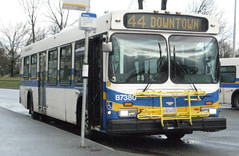
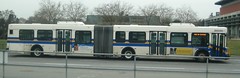

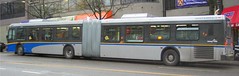
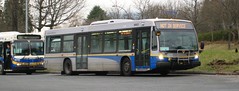
The D40LF and D60LF buses (top two photos) are most common for routes operating out of Burnaby, Surrey and Richmond (as well as C40LFR, bottom photo, out of the Tri-Cities). These are the most familiar to people because the layout is very simple.

In the drawing:
-seats labeled #1 and #2: flip them up!
-restraint belts located below seats labeled #2.
-therefore: vacate if you are in seats #1 or #2.
---
New Flyer E40LFR, E60LFR, D60LFR; Nova Bus
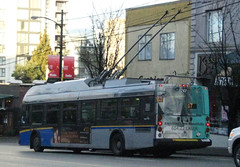
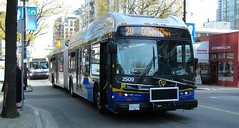
This is where some confusion occurs. The E40LFR and E60LFR buses (top 2 photos) are trolleys; the D60LFR buses are the new articulated buses (third photo from top); and the Nova Bus has the large front windows and wide front doors (bottom photo). The trick here is that the first wheelchair is behind the driver and faces backwards; the second wheelchair faces the front. Here is how it works.

In the drawing:
-seats labeled #1 and #2: if there is no wheelchair in this space, flip these seats up!
-first wheelchair parks at #1; #2 can be flipped back down if space allows it.
-seats labeled #3: if the spot at #1 is already occupied by a wheelchair, flip up all #3 seats.
-restraint belts are below the forward-facing #3 seats -- so all #3 seats MUST be vacated if a second wheelchair comes on!
-therefore: vacate if you are in seats #1; seats #2 may or may not need to be vacated (it depends on space).
-therefore: if #1 is already occupied, vacate seats #3.
---
Orion V
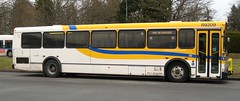
These buses run mostly from Bridgeport Station to Delta, White Rock and South Surrey. There are a few complications here: Orion V buses use lifts instead of ramps and they only have one door. However, the process here is quite straightforward.

In the drawing:
-#1 and #2 seats must be flipped up. Obviously, only one side is needed per wheelchair.
-restraints are below #1 seats and a lap belt is next to #2 seats.
-therefore: vacate #1 and #2 when needed.
---
Community shuttles
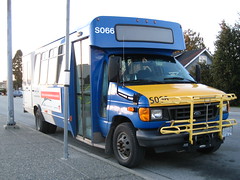
Community shuttles are kind of annoying. The only way for wheelchair users to enter is through a back door. In addition, it uses a lift that requires the driver to exit the vehicle to operate. Lastly, it requires straps and hooks that take forever to set up. Needless to say, these are not my favorite vehicles on the fleet. But nonetheless, they are still necessary.

In the drawing:
-flip up seats #1. These are finicky seats and the driver may need to assist.
-therefore: vacate seats #1.
---
Bus stops

In the drawing:
-accessible bus stops are marked with a wheelchair symbol.
-therefore: allow passengers with disabilities to board first. Simple.
---
SkyTrain: MK1

These SkyTrains are the old ones that first went into operation in the 1980s. They are often associated with the Expo Line but operate on both the Expo and Millennium Lines.

In the drawing:
-there are flip-up seats (#1 and #2) beside the doors. They should automatically flip up when you stand up.
-therefore: vacate seats at #1 or #2 when needed.
---
SkyTrain: MK2
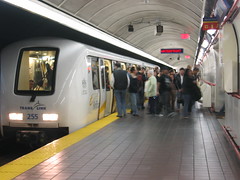
These SkyTrains are the newer ones that went into operation in the late 1990s with similar ones coming in during the 2000s. They are often associated with the Millennium Line but operate on both the Expo and Millennium Lines.

In the drawing:
-flip-up seats are at #1 and #2. However, they are not immediately obvious; look for signs.
-#1 and #2 seats can be flipped up like bus seats.
-therefore: vacate seats #1 or #2 when needed.
---
SkyTrain: Canada Line

The Canada Line trains run exclusively on the Canada Line and have a more spacious inside layout. It is immediately obvious where the designated bike and wheelchair bays are.

In the drawing:
-wheelchair spots are at #1 and bicycle spots are at #2.
-therefore: vacate #1 when needed; #2 is often not needed for wheelchairs but it is still possible.
---
SkyTrain: doors

In the drawing:
-accessible seating is often located near doors with the wheelchair symbol.
-therefore: when boarding, be aware that passengers with disabilities are likely to use this door.
---
SeaBus
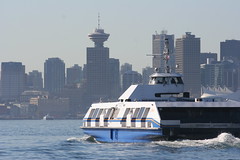
The Seabus connects downtown Vancouver to North Vancouver. There are no flip-up or movable seats to enhance accessibility, so things are a bit different here as well.

In the drawing:
-accessible seating #1 is often at the second door from the front or back of the ferry.
-the seating will always be next to the entrance or exit.
-therefore: if the space is needed, do not clog this area with luggage.

In the drawing:
-SeaBus doors have wheelchair symbols to indicate where the accessible spaces will be located.
therefore: when using these doors, be aware that there may be passengers with disabilities using the same doors to get on (and the same doors at the opposite end to get off).
---
Whew!
That is a lot to cover. I hope it was not overly detailed. So the next time you are wondering if you should vacate your seats or spots, there will be less confusion.
If you are still unsure, pay attention to what the passenger using the wheelchair or the driver is telling you. All of us want to get moving as efficiently as possible!
Those who know the 25 bus don't need to be told how packed, off-schedule and chaotic that route can get. As the bus approached the stop, I looked and saw that it was jam packed. The girl, her mother and I quickly had a verbal plan about how to board the bus. I was going to take the forward-facing spot while she would take the backwards-facing spot. It seemed simple enough.
Of course, it was the 25 bus.
What happened afterwards could only be described as absolute chaos. I knew exactly what to do and where to go. The other passengers, however, didn't. Words can not describe how frustrating it was to repeat, "I need those seats over there" while other people just stood there and stared and the people in the seats I was pointing to were just looked around as if I was talking to somebody else.
It was stupid that it took so long to get the bus going that day. But before you think, "Of course it will take forever; wheelchair passengers always take forever!", consider this: it usually takes me an average of 15 seconds to board and be ready to go. (I'm a speed freak despite my limited walking ability.) With that kind of speed, I doubt that I was the problem. The problem was that other people had no idea how or where to vacate for wheelchair passengers.
I guess I couldn't blame them completely. After all, each bus is different. Perhaps that was part of the problem. So, without further adieu, I bring you the return of my "craptastic art" with this new informational post about the different types of buses/vehicles and which spots exactly to vacate when needed.
(All photos courtesy of BuckyHermit at Flickr.)
---
New Flyer D40LF, D60LF, C40LFR (some)
The D40LF and D60LF buses (top two photos) are most common for routes operating out of Burnaby, Surrey and Richmond (as well as C40LFR, bottom photo, out of the Tri-Cities). These are the most familiar to people because the layout is very simple.

In the drawing:
-seats labeled #1 and #2: flip them up!
-restraint belts located below seats labeled #2.
-therefore: vacate if you are in seats #1 or #2.
---
New Flyer E40LFR, E60LFR, D60LFR; Nova Bus
This is where some confusion occurs. The E40LFR and E60LFR buses (top 2 photos) are trolleys; the D60LFR buses are the new articulated buses (third photo from top); and the Nova Bus has the large front windows and wide front doors (bottom photo). The trick here is that the first wheelchair is behind the driver and faces backwards; the second wheelchair faces the front. Here is how it works.

In the drawing:
-seats labeled #1 and #2: if there is no wheelchair in this space, flip these seats up!
-first wheelchair parks at #1; #2 can be flipped back down if space allows it.
-seats labeled #3: if the spot at #1 is already occupied by a wheelchair, flip up all #3 seats.
-restraint belts are below the forward-facing #3 seats -- so all #3 seats MUST be vacated if a second wheelchair comes on!
-therefore: vacate if you are in seats #1; seats #2 may or may not need to be vacated (it depends on space).
-therefore: if #1 is already occupied, vacate seats #3.
---
Orion V
These buses run mostly from Bridgeport Station to Delta, White Rock and South Surrey. There are a few complications here: Orion V buses use lifts instead of ramps and they only have one door. However, the process here is quite straightforward.

In the drawing:
-#1 and #2 seats must be flipped up. Obviously, only one side is needed per wheelchair.
-restraints are below #1 seats and a lap belt is next to #2 seats.
-therefore: vacate #1 and #2 when needed.
---
Community shuttles
Community shuttles are kind of annoying. The only way for wheelchair users to enter is through a back door. In addition, it uses a lift that requires the driver to exit the vehicle to operate. Lastly, it requires straps and hooks that take forever to set up. Needless to say, these are not my favorite vehicles on the fleet. But nonetheless, they are still necessary.

In the drawing:
-flip up seats #1. These are finicky seats and the driver may need to assist.
-therefore: vacate seats #1.
---
Bus stops

In the drawing:
-accessible bus stops are marked with a wheelchair symbol.
-therefore: allow passengers with disabilities to board first. Simple.
---
SkyTrain: MK1
These SkyTrains are the old ones that first went into operation in the 1980s. They are often associated with the Expo Line but operate on both the Expo and Millennium Lines.

In the drawing:
-there are flip-up seats (#1 and #2) beside the doors. They should automatically flip up when you stand up.
-therefore: vacate seats at #1 or #2 when needed.
---
SkyTrain: MK2
These SkyTrains are the newer ones that went into operation in the late 1990s with similar ones coming in during the 2000s. They are often associated with the Millennium Line but operate on both the Expo and Millennium Lines.

In the drawing:
-flip-up seats are at #1 and #2. However, they are not immediately obvious; look for signs.
-#1 and #2 seats can be flipped up like bus seats.
-therefore: vacate seats #1 or #2 when needed.
---
SkyTrain: Canada Line
The Canada Line trains run exclusively on the Canada Line and have a more spacious inside layout. It is immediately obvious where the designated bike and wheelchair bays are.

In the drawing:
-wheelchair spots are at #1 and bicycle spots are at #2.
-therefore: vacate #1 when needed; #2 is often not needed for wheelchairs but it is still possible.
---
SkyTrain: doors

In the drawing:
-accessible seating is often located near doors with the wheelchair symbol.
-therefore: when boarding, be aware that passengers with disabilities are likely to use this door.
---
SeaBus
The Seabus connects downtown Vancouver to North Vancouver. There are no flip-up or movable seats to enhance accessibility, so things are a bit different here as well.

In the drawing:
-accessible seating #1 is often at the second door from the front or back of the ferry.
-the seating will always be next to the entrance or exit.
-therefore: if the space is needed, do not clog this area with luggage.

In the drawing:
-SeaBus doors have wheelchair symbols to indicate where the accessible spaces will be located.
therefore: when using these doors, be aware that there may be passengers with disabilities using the same doors to get on (and the same doors at the opposite end to get off).
---
Whew!
That is a lot to cover. I hope it was not overly detailed. So the next time you are wondering if you should vacate your seats or spots, there will be less confusion.
If you are still unsure, pay attention to what the passenger using the wheelchair or the driver is telling you. All of us want to get moving as efficiently as possible!
Monday, August 8, 2011
Bus Stop Hop 2011: Bring your best wheels. Wear comfortable shoes.
Yesterday was the 10th annual Bus Stop Hop. For those who don't know what it is, it is an event hosted by the British Columbia Paraplegic Association in partnership with TransLink. In short, it is similar to "The Amazing Race" where you try to hit certain locations and find certain objects/facts faster the teams competing against you.
The twist to this? You must use public transit to reach those places. This includes the bus, SkyTrain, SeaBus and Aquabus. There were fifteen teams and each team consisted of two able-bodied participants and two participants with mobility impairments. My team had one absentee, so we had someone from TransLink (who was originally there to shadow us and take photos) become our unofficial fourth member. The two rolling people on my team consisted of one manual wheelchair user (yours truly) and one power wheelchair user.
It was my first time at the event and it was cool to meet so many new people, and to come across those I've met before -- definitely one of the better networking events I've come across. This year's event was apparently the largest one ever in its ten years of existence.
The day started and ended at Performance Works on Granville Island, and the locations that were required were Vancouver International Airport, the bus cloverleaf on Granville Street at West 5th Avenue, Lonsdale Quay and Science World. At each location, you must obtain a fact and write it down, get a signature from a staff member there, or complete a task.
In addition, there was a trivia sheet that each group completes for points, as well as extra tasks for bonus points. This means that even if a team came in first in terms of time, they can still slip to second or third place because of points.
Each team had their own strategy. It seemed like the majority of them decided to start inward and move outward -- in other words, start at Granville Island and move farther and farther before reaching Vancouver International Airport (the furthest destination). After all, Granville Island had the most tasks and bonus points in the race so many seemed to decide to get them out of the way first.
...which probably meant chaos at the same locations. So our team decided to do almost the opposite -- start farthest away and move inwards to the final destination.
Our idea:
The twist to this? You must use public transit to reach those places. This includes the bus, SkyTrain, SeaBus and Aquabus. There were fifteen teams and each team consisted of two able-bodied participants and two participants with mobility impairments. My team had one absentee, so we had someone from TransLink (who was originally there to shadow us and take photos) become our unofficial fourth member. The two rolling people on my team consisted of one manual wheelchair user (yours truly) and one power wheelchair user.
It was my first time at the event and it was cool to meet so many new people, and to come across those I've met before -- definitely one of the better networking events I've come across. This year's event was apparently the largest one ever in its ten years of existence.
The day started and ended at Performance Works on Granville Island, and the locations that were required were Vancouver International Airport, the bus cloverleaf on Granville Street at West 5th Avenue, Lonsdale Quay and Science World. At each location, you must obtain a fact and write it down, get a signature from a staff member there, or complete a task.
In addition, there was a trivia sheet that each group completes for points, as well as extra tasks for bonus points. This means that even if a team came in first in terms of time, they can still slip to second or third place because of points.
Each team had their own strategy. It seemed like the majority of them decided to start inward and move outward -- in other words, start at Granville Island and move farther and farther before reaching Vancouver International Airport (the furthest destination). After all, Granville Island had the most tasks and bonus points in the race so many seemed to decide to get them out of the way first.
...which probably meant chaos at the same locations. So our team decided to do almost the opposite -- start farthest away and move inwards to the final destination.
Our idea:
- Go to the 5th Avenue bus loop: [first location]
- From there, catch the 50 False Creek South bus to the Canada Line.
- Take the Canada Line to Vancouver International Airport: [second location]
- Take the Canada Line to Waterfront Station.
- Take the SeaBus to Lonsdale Quay: [third location]
- Take the SeaBus back to Waterfront Station.
- Take the SkyTrain to Science World: [fourth location]
- Take the Aquabus from Science World to Granville Island: [fifth location] *
- Complete all the Granville Island bonus tasks.
In short, our routing was planned to look like this:
View Bus Stop Hop route 1 in a larger map
We had it all planned out. So while everyone else tackled locations closer to home, we set out for the 5th Avenue bus stop.
And then my wheelchair decided to malfunction.
What happened was that my footplate's bolts were loosening up and the footplate slid to the point where it was scraping the ground. It was kind of dire for a few moments as we went up the hill adjacent and below the Granville Street Bridge. Somehow, we made it and as the task at the stop was bring handed off to my partner, I took the time to make a pit stop repair; thankfully my partner had a tool kit handy (lesson learned; I'm going to the hardware store tomorrow).
---
EDIT: Access Eco BC blog has a photo of the wheelchair malfunction. My "greatest" moment captured on camera!
---
We were the first team to that location and we had luck on our side at the start. We did not have to wait for more than a few minutes for any of the buses or SeaBuses until our return from Lonsdale Quay.
At the airport, we finally ran into some of the other teams. But we were confident; we were certain that nobody else had the 5th Avenue bus loop yet, so we were probably one stop "ahead" of the others. We completely blazed through all of the locations until after Lonsdale Quay, when we narrowly missed a SeaBus by a couple of minutes, resulting in a 15-minute wait for the next trip. Our momentum hit a snag.
Our next stop was Science World, which was conveniently under renovation. There was a bit of confusion as the lady at the information desk was not told about the Bus Stop Hop; this lapse allowed some of the other teams to catch up in the meantime.
After that, we thought we were home free -- one more Aquabus ride back to Granville Island to complete the final tasks, and that was it!
Or so we thought.
Because, you see, this is 2011. This is the digital age. That means unless something has "LOL" or "OMG" in it, we are not likely to read it.
We completely missed the tidbit in the instructions saying that the Aquabus was only running accessible services between Granville Island and... David Lam Park. From Science World, taking transit to David Lam Park was difficult if not nearly impossible on a Sunday schedule with two wheelchair users at the same time.
So we decided to hike it.
My partner kicked his power chair into high gear and I went into my wheelchair racing mindset. Our TransLink staff member had to leave after Science World, so our lone able-bodied team member had to jog it -- in her sandals/flip-flops.
It was no short trip by any means and she had to actually run to keep up with the team's high-speed power wheelchair user and rabid (though occasional) wheelchair racer. I have no idea how she did it, but she survived all the way to David Lam Park. (I had to hold on to my power wheelchair partner for a lift for about 10% of the way, so it was quite insane.)
So eventually THIS became our route (pay attention to the False Creek area):
View Bus Stop Hop route 2 in a larger map
After accomplishing the tasks there, we arrived back at base camp on Granville Island, answered the trivia questions and sent our stuff in. Third place! (We later slipped out of that position due to points, but anyways... THIRD PLACE!!! -- in our deluded little minds where leprechauns rule the Earth.)
All in all, it was pretty fun. Just waiting for the aches to kick in from yesterday's wheeling sprint from Science World to Yaletown. It hasn't happened yet but it probably will in a bit, which should be awesome.
Random post-blog thought:
(Next year, maybe have a friend stand by at Science World with a racing wheelchair. Fool me once, shame on you. Fool me twice...)
Subscribe to:
Posts (Atom)


