Showing posts with label wheelchair. Show all posts

Sunday, March 25, 2012

Chairs on a plane

This blog talks about public transportation. Many people don't think of air travel as public transportation but it meets the characteristics required: you share a vehicle and space with other people to get from one location to another. So here is the first ever air travel blog entry for Priority Seating!

One of the things that people might not see everyday is a wheelchair user getting on a plane. I find it fascinating that airports are places where you are likely to see a wheelchair but most of the time it's a rented/borrowed "hospital clunker" chair and not a permanent wheelchair that you usually see from a long-term user. Of course, those chairs are meant to be used for a few hours at a time and usually belong to the airport or airline, and they are left at the airport once the flight leaves.


The "hospital clunker": often seen at airports as rental wheelchairs.

But what about people who use their own wheelchairs? It occurred to me that this is something that able-bodied people and people with disabilities (who have never flown) often wonder about. Some people may not know the procedure. So for this entry, I will outline the general procedure using a recent flight I took from Vancouver to Victoria, British Columbia.

To start with, I don't use a "hospital clunker" but rather a "fancy sleek wheelchair," which obviously looks/performs a lot better since it is usually designed for those with long term or permanent disabilities.


The "fancy sleek wheelchair": similar to mine.

Of course, with a wheelchair like that, you want to make sure it is taken care of. As well, you want to use your own wheelchair as much as possible until you have to board the plane. At most North American airports, this should be fine.

One very important thing to ask for when you check in is a "gate tag," also sometimes called a "door tag"." Basically what it does is allow you to bring something (in this case, your wheelchair) right to the gate and have it stowed in the cargo hold once you board.

This is something that is commonly done for those with other mobility devices such as walkers as well. As standard practice, wheelchairs, walkers and other mobility devices do not count as another piece of checked-in luggage; airlines are supposed to take them for no extra charge.


The "gate tag" on my wheelchair at the airport.

One of the upsides of being in a wheelchair is that airlines sometimes bump you up a class when selecting your seating. This is mainly for practicality reasons, if economy class is far from the plane's entrance. For my particular flight, I had this happen, but it made little difference since the plane only seated thirty or so people.

One of the downsides, however, is that you are the first person to board the plane and last person to get off. That means that you should arrive earlier than most people and leave more time to get to where you want to go after you land.

For airport security, wheelchair users have to swallow their dignity in a way. Able-bodied people usually go through a metal detector. Guess what – wheelchair users are sitting on metal! In addition, wheelchair users often have metal rods in their spines from previous operations and whatnot, which can set off the machine. The solution? The good ol' pat-down.

You are allowed to ask to get the pat-down in a back room instead of out in the open. Usually it is not a big deal. They will ask if there are parts of your body that are sensitive to pain. The pat-down is usually thorough enough without being intrusive (and those that aren't usually end up on the news). The security person should have done this before, so things that you have such as leg-bags, colostomy pouches, etc. should be obvious enough; my security guy at Vancouver airport asked, for confirmation, but he already "knew." It was not a big deal (and it shouldn't be).

Now here is the real question from many people – how do you actually board the airplane? This will depend on two things. The first thing is the type of plane: for example, whether you board from the tarmac or from a jet way. The second thing is your ability level: whether you can walk well, or with difficulty, or not at all.

Jet ways are easy. However, my flight was on a small plane and boarding was from the tarmac. Usually for those planes, they have small flights of stairs that can be used. Obviously that is not an option for me, so they have a special foldable ramp that can replace the stairs when needed. At the end, what you basically have is a ten- or fifteen-meter ramp leading from the tarmac to the plane. (Of course, with jet ways, this doesn't apply.)

Your ability level then becomes the second factor. For jet ways, those who can walk with difficulty or short distances may be able to go from their wheelchair directly to their seats. However, I belong to the category that isn't able to do that. In that case, something called an "aisle chair" is needed.


An airplane aisle chair (my nickname for it: "Hannibal Lector chair").

To board the plane, I must transfer from my wheelchair to this aisle chair. At this point, it is best to grab any loose parts from my wheelchair (such as the cushion or side guards) because this is the time when they will take your wheelchair away to be stowed in the cargo hold. Also, if you have limited sensation in your lower body, sitting on your wheelchair cushion during the flight may be a good idea anyway. (For those who don't know, we sit on wheelchair cushions to distribute pressure and reduce chances of pressure sores.)

The aisle chair is designed to be narrow enough to fit through the aisles of the plane, which are much narrower than conventional aisles on trains and buses. The user is strapped in like Hannibal Lector, which is why I nicknamed it the "Hannibal Lector chair." Even those with good trunk balance may need it because assistance from airport crew is required to use the chair, and the ride can be a bit bumpy/rough: it is not possible to use it on your own. As someone who likes his independence, this was one of those times when you have to "suck it up" and accept assistance from others.

The plane I had was a regional plane so the aisles were narrower than larger international planes. Because of that, I had to tuck my arms in like a mummy. This is a good precaution to take regardless of which plane you get. The aisle chair will be rolled to your seat, where you can transfer onto it.

When you get off the plane, it is the opposite procedure.

With that said, air travel does tend to have drawbacks for wheelchair users. One big issue for some people I know is the potential for your wheelchair to get damaged. Some people recommend taking photos of your wheelchair before you travel in case something does happen.

Another issue is that if your ability level is a concern, you will need to communicate very directly to the airport crew, especially during the aisle chair process. Leave no room for mistakes.

Also, for longer flights, those who cannot walk independently may have to refrain from drinking too much. While some planes have aisle chairs on board, others may not. The bathroom itself may not be accessible (or not as accessible as you need it to be). Dehydration is not a good thing but in this case it may be slightly necessary.

That is more or less all I can think of for airplane travel as a wheelchair user. I am sure there are other points that I am missing but I will add those later as I come across them.

---

UPDATE: Here is an example of what can go wrong during this process.

Monday, November 7, 2011

Location, location

The other day, I was leaving GF Strong Rehab Centre in Vancouver and headed to the bus stop. When I got there, there were a few people waiting. Among them was a woman with her daughter, who was in a wheelchair like me. We were both waiting for the 25 bus.

Those who know the 25 bus don't need to be told how packed, off-schedule and chaotic that route can get. As the bus approached the stop, I looked and saw that it was jam packed. The girl, her mother and I quickly had a verbal plan about how to board the bus. I was going to take the forward-facing spot while she would take the backwards-facing spot. It seemed simple enough.

Of course, it was the 25 bus.

What happened afterwards could only be described as absolute chaos. I knew exactly what to do and where to go. The other passengers, however, didn't. Words can not describe how frustrating it was to repeat, "I need those seats over there" while other people just stood there and stared and the people in the seats I was pointing to were just looked around as if I was talking to somebody else.

It was stupid that it took so long to get the bus going that day. But before you think, "Of course it will take forever; wheelchair passengers always take forever!", consider this: it usually takes me an average of 15 seconds to board and be ready to go. (I'm a speed freak despite my limited walking ability.) With that kind of speed, I doubt that I was the problem. The problem was that other people had no idea how or where to vacate for wheelchair passengers.

I guess I couldn't blame them completely. After all, each bus is different. Perhaps that was part of the problem. So, without further adieu, I bring you the return of my "craptastic art" with this new informational post about the different types of buses/vehicles and which spots exactly to vacate when needed.

(All photos courtesy of BuckyHermit at Flickr.)

---

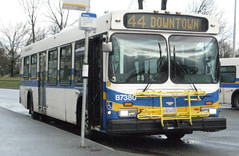
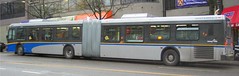
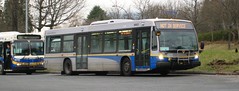
New Flyer D40LF, D60LF, C40LFR (some)


The D40LF and D60LF buses (top two photos) are most common for routes operating out of Burnaby, Surrey and Richmond (as well as C40LFR, bottom photo, out of the Tri-Cities). These are the most familiar to people because the layout is very simple.


In the drawing:
-seats labeled #1 and #2: flip them up!
-restraint belts located below seats labeled #2.
-therefore: vacate if you are in seats #1 or #2.

---

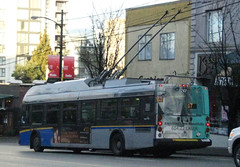
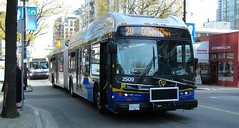
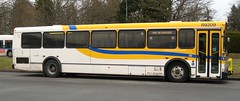
New Flyer E40LFR, E60LFR, D60LFR; Nova Bus


This is where some confusion occurs. The E40LFR and E60LFR buses (top 2 photos) are trolleys; the D60LFR buses are the new articulated buses (third photo from top); and the Nova Bus has the large front windows and wide front doors (bottom photo). The trick here is that the first wheelchair is behind the driver and faces backwards; the second wheelchair faces the front. Here is how it works.


In the drawing:
-seats labeled #1 and #2: if there is no wheelchair in this space, flip these seats up!
-first wheelchair parks at #1; #2 can be flipped back down if space allows it.
-seats labeled #3: if the spot at #1 is already occupied by a wheelchair, flip up all #3 seats.
-restraint belts are below the forward-facing #3 seats -- so all #3 seats MUST be vacated if a second wheelchair comes on!
-therefore: vacate if you are in seats #1; seats #2 may or may not need to be vacated (it depends on space).
-therefore: if #1 is already occupied, vacate seats #3.

---

Orion V


These buses run mostly from Bridgeport Station to Delta, White Rock and South Surrey. There are a few complications here: Orion V buses use lifts instead of ramps and they only have one door. However, the process here is quite straightforward.


In the drawing:
-#1 and #2 seats must be flipped up. Obviously, only one side is needed per wheelchair.
-restraints are below #1 seats and a lap belt is next to #2 seats.
-therefore: vacate #1 and #2 when needed.

---

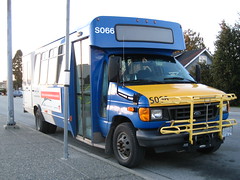
Community shuttles


Community shuttles are kind of annoying. The only way for wheelchair users to enter is through a back door. In addition, it uses a lift that requires the driver to exit the vehicle to operate. Lastly, it requires straps and hooks that take forever to set up. Needless to say, these are not my favorite vehicles on the fleet. But nonetheless, they are still necessary.


In the drawing:
-flip up seats #1. These are finicky seats and the driver may need to assist.
-therefore: vacate seats #1.

---

Bus stops


In the drawing:
-accessible bus stops are marked with a wheelchair symbol.
-therefore: allow passengers with disabilities to board first. Simple.

---

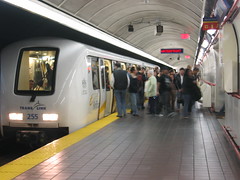
SkyTrain: MK1


These SkyTrains are the old ones that first went into operation in the 1980s. They are often associated with the Expo Line but operate on both the Expo and Millennium Lines.


In the drawing:
-there are flip-up seats (#1 and #2) beside the doors. They should automatically flip up when you stand up.
-therefore: vacate seats at #1 or #2 when needed.

---

SkyTrain: MK2


These SkyTrains are the newer ones that went into operation in the late 1990s with similar ones coming in during the 2000s. They are often associated with the Millennium Line but operate on both the Expo and Millennium Lines.


In the drawing:
-flip-up seats are at #1 and #2. However, they are not immediately obvious; look for signs.
-#1 and #2 seats can be flipped up like bus seats.
-therefore: vacate seats #1 or #2 when needed.

---

SkyTrain: Canada Line


The Canada Line trains run exclusively on the Canada Line and have a more spacious inside layout. It is immediately obvious where the designated bike and wheelchair bays are.


In the drawing:
-wheelchair spots are at #1 and bicycle spots are at #2.
-therefore: vacate #1 when needed; #2 is often not needed for wheelchairs but it is still possible.

---

SkyTrain: doors


In the drawing:
-accessible seating is often located near doors with the wheelchair symbol.
-therefore: when boarding, be aware that passengers with disabilities are likely to use this door.

---

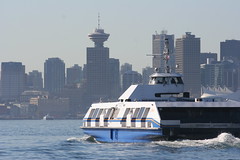
SeaBus


The Seabus connects downtown Vancouver to North Vancouver. There are no flip-up or movable seats to enhance accessibility, so things are a bit different here as well.


In the drawing:
-accessible seating #1 is often at the second door from the front or back of the ferry.
-the seating will always be next to the entrance or exit.
-therefore: if the space is needed, do not clog this area with luggage.


In the drawing:
-SeaBus doors have wheelchair symbols to indicate where the accessible spaces will be located.
therefore: when using these doors, be aware that there may be passengers with disabilities using the same doors to get on (and the same doors at the opposite end to get off).

---

Whew!

That is a lot to cover. I hope it was not overly detailed. So the next time you are wondering if you should vacate your seats or spots, there will be less confusion.

If you are still unsure, pay attention to what the passenger using the wheelchair or the driver is telling you. All of us want to get moving as efficiently as possible!

Thursday, October 6, 2011

No room to spare

Did you know that TransLink offers all people a chance to test out whether their wheelchair, scooter or other mobility device will fit on board a bus?

Before my first time on board a bus in my wheelchair, I had never tested it out. I am fortunate to have a relatively compact and sleek wheelchair that can squeeze through many small spaces, but not everyone has one. If you are in doubt about whether your mobility device can get on the bus, it might be a good idea to take advantage of TransLink's offer to test it out on a not-in-service bus first.

Otherwise, something like this could happen:

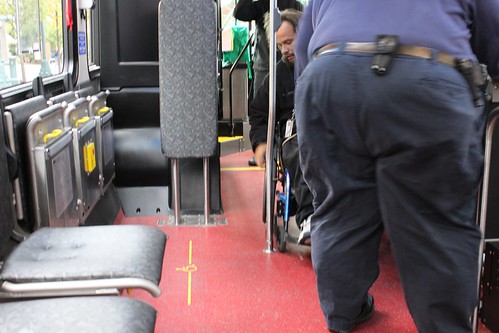
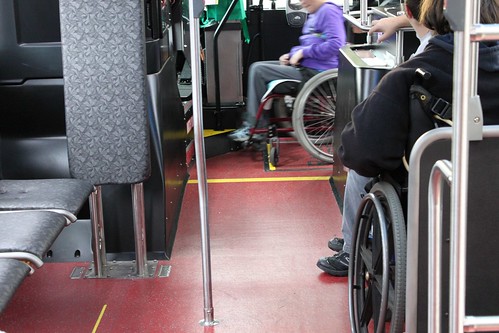
(Photos from Oran Viriyincy at Flickr, taken near Seattle, WA)

Does not fit
Does not fit: Because of the people sitting on the right side, this man in a wheelchair can not go around the stanchion to use the passive restraint (his first choice). He ended up using the traditional straps.

Still does not fit
Still does not fit: the lady in the wheelchair can not go around the stanchion to use the passive restraint because there isn't enough room to maneuver around it. She, with assistance, boarded through the middle door to get to the passive restraint position.

Two wheelchairs on the B Line
Two wheelchairs on the B Line: One passive restraint (boarded through middle door with assistance, no ramp), One forward facing position (through front door ramp).

Whew! That took a long time. Speaking as a wheelchair user, I hate delaying other people's commutes and my own for something as simple as getting on or off a bus.

TransLink's buses are pretty good when it comes to accessibility, but one bus that makes the above situation unlikely is the Nova Buses (the ones with the double doors at the front). Those buses get a lot of grief from able-bodied riders but in terms of accessibility, they are wonderful – wider front entrance, front wheel moved back (making it less of an obstruction), plenty of space to maneuver in the front and so on.

However, that doesn't mean that anyone can manage those buses on the first try. If you have any concerns or doubts about getting on or off with a mobility device, take advantage of TransLink and Coast Mountain Bus Company's offer and test it out at their depot. More information is found here (look for "Travel Training").

Wednesday, August 17, 2011

Strapped in and ready to rock

When taking a bus, one of the most interesting things that I notice is how others hook up or strap down their wheelchairs. It seems like everyone has their own method or preferred hooking up/strapping down method.


I apologize for the craptastic art.

The first thing to consider is that everyone's wheelchair is different. It's just like how people drive different cars. My wheelchair has things that others don't, and vice versa. I mentioned on Twitter how no two people load their wheelchair the same way – it's because everyone's chair and car are different.

Instead of seeking a single universal answer, it may be helpful to think about where is a "good" place to place the wheelchair restraints and where is a "bad" place to do it.


Handrims are stable hooking-up/strapping-in places... right?

When assisting, some drivers immediately try to use the restraints on the handrims or rear wheels of the wheelchair. This is a BAD idea.

There is the misconception that the wheel is a stable part on a wheelchair because, well, the whole reason the chair moves is because of the wheel! But for most rigid manual wheelchairs, the wheels can detach (part of the mechanism that makes it easier to store the chair). You don't want to be attaching a vital safety restraint on a removable part.

In addition, wheels can be damaged or bent due to force. I have heard of cases where using the wheel as a location for the restraints has resulted in a bent wheel, resulting in expensive repair costs. (I have Spinergy wheels on my chair and they routinely cost $600 a pair.)


The backrest should be an obvious place to strap down the chair... right?

Another seemingly obvious place to place the restraints is the backrest bar. After all, it's one of the closest areas to the restraint belts on a bus, right?

Well, it is the closest for sure. But I don't find that it is a safe place to strap down a wheelchair either. There are two big reasons why I don't think so.

The first reason is exclusively for rigid manual wheelchair users. Many rigid chairs cannot be folded down vertically (as in folding it down until the rear wheels are an inch apart from each other). Instead, they rely on the backrest folding DOWN on to the seat. As you can guess, since the backrest is a moving part, you don't want to be compromising its structural integrity by using it for a restraint belt.

My other reason has to do with safety and applies to all manual wheelchairs. Some people don't think of this, but wheelchairs can tip backwards. There are many methods to tip backwards (mostly to do "wheelies"). I tend to use my hips. But some others use their backs, which means – you guessed it! – putting force on the backrest. Imagine strong G-forces being applied on the backrest. It would be the ultimate wheelie, a.k.a. falling backwards and knocking your head on the ground.


Okay, how about using a non-moving part?

Another possible area to put the wheelchair restraint belts is on the axle area. This axle is also known as the "centre of gravity" bar. While it is movable, it requires strong tools to do so. I have great hand function and arm strength and believe me, you may need VERY strong tools and willpower to adjust it. Putting force on this axle will not cause the wheelchair user to tip backwards and it would take some extreme effort to make it move. This should be a good place to put the restraint belts, right?

I have never tried to use that bar, nor do I wish to. Why? Because I simply don't know if it would be damaged if the bus brakes and G-forces are applied to it. That bar is one of the most vital parts to a wheelchair that would be a complete nightmare to replace (and perhaps it might even be un-replaceable). I can't say it's a BAD idea to use it, but I can't say it's a GOOD idea either. It would be a huge risk to even test it, in my view. If anyone has input about this, please post in the comments; I'd appreciate it.


The method that is least risky to me and my chair.

My method is to choose a spot that is least likely to move, bend, or become damaged – the front bar, just above my casters. That bar doesn't look as secure as the other locations I mentioned, but for a titanium frame, it is least likely to bend. It will not move no matter what. It does not affect any moving parts. It is also easy to reach when getting off the bus. And it won't tip my chair over, which is a big plus. In short, it is nearly a foolproof place for the restraints.

Some drivers have expressed doubt over the security of this method. To the naked eye, it actually does look like a flimsy way to strap down a wheelchair. But this is the only method I've tried that has NEVER given me any problems. I've even been on a bus that had a collision before and this method passed the test. So when drivers look and ask, "Are you sure that's where you want the restraints?", I just look at them and say, "Definitely."

Do you have a preferred method of hooking up your wheelchair on a bus?

Monday, August 8, 2011

Bus Stop Hop 2011: Bring your best wheels. Wear comfortable shoes.

Yesterday was the 10th annual Bus Stop Hop. For those who don't know what it is, it is an event hosted by the British Columbia Paraplegic Association in partnership with TransLink. In short, it is similar to "The Amazing Race" where you try to hit certain locations and find certain objects/facts faster the teams competing against you.

The twist to this? You must use public transit to reach those places. This includes the bus, SkyTrain, SeaBus and Aquabus. There were fifteen teams and each team consisted of two able-bodied participants and two participants with mobility impairments. My team had one absentee, so we had someone from TransLink (who was originally there to shadow us and take photos) become our unofficial fourth member. The two rolling people on my team consisted of one manual wheelchair user (yours truly) and one power wheelchair user.

It was my first time at the event and it was cool to meet so many new people, and to come across those I've met before -- definitely one of the better networking events I've come across. This year's event was apparently the largest one ever in its ten years of existence.

The day started and ended at Performance Works on Granville Island, and the locations that were required were Vancouver International Airport, the bus cloverleaf on Granville Street at West 5th Avenue, Lonsdale Quay and Science World. At each location, you must obtain a fact and write it down, get a signature from a staff member there, or complete a task.

In addition, there was a trivia sheet that each group completes for points, as well as extra tasks for bonus points. This means that even if a team came in first in terms of time, they can still slip to second or third place because of points.

Each team had their own strategy. It seemed like the majority of them decided to start inward and move outward -- in other words, start at Granville Island and move farther and farther before reaching Vancouver International Airport (the furthest destination). After all, Granville Island had the most tasks and bonus points in the race so many seemed to decide to get them out of the way first.

...which probably meant chaos at the same locations. So our team decided to do almost the opposite -- start farthest away and move inwards to the final destination.

Our idea:
  • Go to the 5th Avenue bus loop: [first location]
  • From there, catch the 50 False Creek South bus to the Canada Line.
  • Take the Canada Line to Vancouver International Airport: [second location]
  • Take the Canada Line to Waterfront Station.
  • Take the SeaBus to Lonsdale Quay: [third location]
  • Take the SeaBus back to Waterfront Station.
  • Take the SkyTrain to Science World: [fourth location]
  • Take the Aquabus from Science World to Granville Island: [fifth location] *
  • Complete all the Granville Island bonus tasks.
* Remember this step. You'll see why later.

In short, our routing was planned to look like this:

View Bus Stop Hop route 1 in a larger map

We had it all planned out. So while everyone else tackled locations closer to home, we set out for the 5th Avenue bus stop.

And then my wheelchair decided to malfunction.

What happened was that my footplate's bolts were loosening up and the footplate slid to the point where it was scraping the ground. It was kind of dire for a few moments as we went up the hill adjacent and below the Granville Street Bridge. Somehow, we made it and as the task at the stop was bring handed off to my partner, I took the time to make a pit stop repair; thankfully my partner had a tool kit handy (lesson learned; I'm going to the hardware store tomorrow).

---
EDIT: Access Eco BC blog has a photo of the wheelchair malfunction. My "greatest" moment captured on camera!
---

We were the first team to that location and we had luck on our side at the start. We did not have to wait for more than a few minutes for any of the buses or SeaBuses until our return from Lonsdale Quay.

At the airport, we finally ran into some of the other teams. But we were confident; we were certain that nobody else had the 5th Avenue bus loop yet, so we were probably one stop "ahead" of the others. We completely blazed through all of the locations until after Lonsdale Quay, when we narrowly missed a SeaBus by a couple of minutes, resulting in a 15-minute wait for the next trip. Our momentum hit a snag.

Our next stop was Science World, which was conveniently under renovation. There was a bit of confusion as the lady at the information desk was not told about the Bus Stop Hop; this lapse allowed some of the other teams to catch up in the meantime.

After that, we thought we were home free -- one more Aquabus ride back to Granville Island to complete the final tasks, and that was it!

Or so we thought.

Because, you see, this is 2011. This is the digital age. That means unless something has "LOL" or "OMG" in it, we are not likely to read it.

We completely missed the tidbit in the instructions saying that the Aquabus was only running accessible services between Granville Island and... David Lam Park. From Science World, taking transit to David Lam Park was difficult if not nearly impossible on a Sunday schedule with two wheelchair users at the same time.

So we decided to hike it.

My partner kicked his power chair into high gear and I went into my wheelchair racing mindset. Our TransLink staff member had to leave after Science World, so our lone able-bodied team member had to jog it -- in her sandals/flip-flops.

It was no short trip by any means and she had to actually run to keep up with the team's high-speed power wheelchair user and rabid (though occasional) wheelchair racer. I have no idea how she did it, but she survived all the way to David Lam Park. (I had to hold on to my power wheelchair partner for a lift for about 10% of the way, so it was quite insane.)

So eventually THIS became our route (pay attention to the False Creek area):

View Bus Stop Hop route 2 in a larger map

After accomplishing the tasks there, we arrived back at base camp on Granville Island, answered the trivia questions and sent our stuff in. Third place! (We later slipped out of that position due to points, but anyways... THIRD PLACE!!! -- in our deluded little minds where leprechauns rule the Earth.)

All in all, it was pretty fun. Just waiting for the aches to kick in from yesterday's wheeling sprint from Science World to Yaletown. It hasn't happened yet but it probably will in a bit, which should be awesome.

Random post-blog thought:

(Next year, maybe have a friend stand by at Science World with a racing wheelchair. Fool me once, shame on you. Fool me twice...)

Wednesday, July 27, 2011

Wheelchairs don't affect hearing

A common phrase that parents say to their kids is, "If you don't have anything nice to say, then don't say anything at all."

I have a new phrase I would like to propose: "If you want to say something bad about someone, don't pretend that person is deaf."

Today, I was waiting for a Vancouver-bound bus at Park Royal in West Vancouver. Since it is summertime, there were a lot of young people at the stop who were enjoying their freedom from school. There was a group of teen boys nearby; one of the boys had an injured ankle and was using crutches.

Since the Park Royal stop is a bit narrow and it is difficult for bus drivers to be able to see wheelchair-using passengers through the crowd, I decided to head towards the bus stop pole. I passed by this group. They didn't seem to notice me at first. But then they did, and what I heard next was simply astounding.

One of the teenagers said, "I hate it when a wheelchair has to get on the bus."

The teenager with the crutches said, "I know. They're a bunch of assholes. I've been in a wheelchair before. It's not that bad. They're just making it seem worse than it is."

And they did this about two metres from me, in plain earshot. They did not even try to hide what they were talking about -- no lowering their volumes or speaking in hushed voices. It was blunt and direct, and offensive in the worst way possible.

This reminds me so much of some of the tweets I see on Twitter over and over again, every single week:

Why wheelchair ppl only wanna get on da bus when im late son..wheel yaself to ya destinationless than a minute ago via twidroyd Favorite Retweet Reply


Idk why people in a wheelchair get on the bus I mean they can drive themselves wherever they need to goless than a minute ago via Twitter for BlackBerry® Favorite Retweet Reply


Anytime I'm running late the person in the wheelchair want to get on my bus. Roll ya ass to where u need to go !less than a minute ago via Tweetlogix Favorite Retweet Reply


Every time I do a search on Twitter looking for content to re-tweet, I come across these all the time. Actually, I could care less about these people because they obviously do not have the reasoning skills to think about what wheelchair users go through. But if you have these kind of thoughts, keep them to yourself. Do not go around saying these things out loud, especially in front of the person you are talking about who has normal hearing.

That teenager has ZERO idea what it is like, yet he not only runs his mouth but also belittles people with disabilities. He obviously has no idea how to treat his fellow human beings. By the looks of it, he is nearing the final years of high school. It is time for him to grow up and be more mature.

Tuesday, May 24, 2011

"Priority" seating

The other day, Jen at TransLink Tales came up with some thoughts about "seat hierarchies" on public transit in Metro Vancouver.

It's very interesting how it works. There seems to be no clear unwritten universal rule; what I've noticed in Metro Vancouver may not be applicable in a place like, let's say, Hong Kong or even Los Angeles.

The only one that seems even remotely universal is... priority seating. (That may be the worst segway into using this blog's title, ever.) In all of the places I've been to throughout the world, wherever there is special designated priority seating for those in need such as people with disabilities, the rule seems to be the same -- get out of our way, b*tches. (Honestly, I'll stop with that now.)

However, one thing that makes the TransLink system so darned interesting is that there is a sort of seating hierarchy among those using the designated priority seating as well. Here, I will give several scenarios that I've encountered. Please note that these are only my own experiences and may not apply to others' experiences. Also, this is likely Rebecca Black's worst seating nightmare.

Scenario #1: Two wheelchair users (one manual wheelchair, one battery-powered wheelchair) getting on at the same stop.

There seems to be no real rule but for some reason, in every single situation I've been involved in, the person with the battery-powered chair gets on first. This may be because a) that chair can climb the ramp faster, b) it needs more space once on board anyway and c) driver assistance is usually needed for battery-powered chairs. While the driver is otherwise occupied, manual wheelchair users with good hand function (like me) can strap ourselves in.

I have never tried this on a 351/601 bus (with the hydraulic lifts) though. I'd imagine it would be similar.

Scenario #2: Two wheelchair users (both the same type of wheelchairs) getting on at the same stop.

Usually we figure out who goes first, one way or another. Or we fight to the death. Whichever works.

Scenario #3: Two wheelchair users (one manual wheelchair, one battery-powered wheelchair) getting on at the same stop -- on to a newer bus with rear-facing spots.

Usually, the battery-powered wheelchair tends to get the rear-facing spot mostly because the logistics of using straps on a manual wheelchair are less complicated and less time consuming (for both strapping and unstrapping).

Scenario #4: A wheelchair user gets on a newer bus with rear-facing spots.

Regardless of the types of wheelchairs, the "first come, first served" rule is the default here as far as I know. I guess this is because it's difficult enough maneuvering one wheelchair on board a bus, let alone two -- a simple shuffling of wheelchairs to match the results of Scenario #3 would be tough to do. (Also, standing crowds on buses can make such a shuffling impossible.)

Scenario #5: Two wheelchair users (one manual wheelchair, one battery-powered wheelchair) get off at the same stop.

The manual wheelchair user tends to get off first because he/she often gets unstrapped the fastest. But even when both people are unstrapped, I find that the manual wheelchair user gets off first regardless. Don't quote me on that; I've yet to encounter anything different but you never know.

Scenario #6: Two wheelchair users (same type of wheelchair) getting off at the same stop.

Fight to the death.

Scenario #7: A wheelchair user gets on, but both sides of the priority seating are occupied by the elderly or people with other disabilities.

Usually, the side with the fewest people in need will be asked to vacate the seats. It's rare that both sides would have the same number of such people. (Usually other people would offer their seats to those in need who had to vacate.)

Tuesday, March 15, 2011

"A long time ago, we used to be friends"

(Yes, this blog post's title is taken from the theme song of "Veronica Mars.")

---

This morning, I came across the following on Twitter:

Jeez, no matter how late I'm running, I'd never yell at someone in a wheelchair for "slowing down the bus". #shakesheadless than a minute ago via Twitter for Android


It seems like a nonchalant tweet that doesn't mean much. But there is much more to this tweet than meets the eye.

If you do a simple search on Twitter for "wheelchair" and "bus," you will find that there are a lot of angry commuters out there who find wheelchair users on public transit to be a nuisance. The general gist of it is, "I'm in a rush and now a wheelchair user needs to get on. Stupid wheelchair users, making me late for work/school/etc." There are other various complaints as well.

What's interesting is that some wheelchair users today might have been one of those people once.

The other day, I attended a wheelchair basketball clinic at Douglas College in New Westminster. If you know the location and its topography, you will recall that the campus is very close to the SkyTrain station -- but has a 33-degree incline between the station and campus. Obviously going up (or down) that hill in a wheelchair is not really something you want to do, especially when it is raining like it was that day.

So instead of risking life and limb, I decided to simply take a bus from the station, even though it is only a one-stop ride. I didn't feel good about taking up all that time boarding/de-boarding for a one-stop journey, but what other choice is there?

At the basketball clinic a few hours later, I was chatting with someone else who I had previously met at GF Strong Rehab Centre during another event and the steep hill entered the conversation, and subsequently the necessary bus ride.

When I mentioned how it was uncomfortable taking that much time for only one stop away, the person said, "You know... It's interesting because before I was in a wheelchair, I was one of those people who would HATE it when someone in a chair had to get on. So when I got in a chair, I would avoid the bus as much as possible because of that." She said she got over that after a while, though obviously both of us agreed that it was best to get on and off as quickly as possible.

I think there is a certain transition period when you first start using a wheelchair. One of the steps in the transition is going from someone relatively anonymous to a sort of "performer" who is being watched by the audience. The bus is one such stage, and when all eyes are on you, it feels rather scary that you are now the centre of attention.

Of course, when you watch something, time tends to slow down. ("A watched pot never boils" comes to mind here.) I have a theory that is the reason why there are so many upset commuters out there who direct their frustration at wheelchair users, because we are so visible. It's much less common that you would hear the same frustration at people who are slow at taking out their fares or who have to ask the bus driver questions.

There is a certain level of discomfort for us wheelchair users too because we are being watched and have no idea whether you're watching for curiosity or watching while thinking, "Stupid wheelchair user. Let's roll him/her off a cliff or feed him/her to a pack of wolves or something." It may be paranoia talking but I have always found this rather unnerving and it takes a while to get used to.

In short, being a "performer" rattles me and these negative comments I keep seeing don't help. If you feel angry or upset at wheelchair users on the bus, consider the fact that perhaps we once shared the same thoughts as you and we don't want to be in our present condition any more than you want us to delay your commute. I really hope that one day most people wouldn't get so upset about wheelchair users sharing the same need to commute by public transit.

(If you really need to be in a rush on most days, perhaps consider adopting the "30 Minute Rule" at the bottom of this previous blog entry.)

Sunday, February 27, 2011

Wait your turn, or be whacked!

One of the pet peeves I have is people who are impatient when it comes to loading passengers in wheelchairs on the bus. Yes, I get that you're in a hurry and have places to go. I do too! But sometimes you have to take several things into consideration.

When able-bodied people line up for the bus, it's a very simple process. You stand at the bus stop, wait for the bus to come, the door opens, and you get on.

For wheelchair users, it's a bit more complicated than that. If you don't realize it and let your impatience get the better of you, you're going to get WHACKED. No, I'm not threatening you. You will literally get whacked. I will explain.

Imagine a regular low-floor bus. Imagine the process of loading a passenger in a wheelchair. First, it has to stop. Then the doors open. And here's where people's impatience gets them in trouble -- the ramp unfolding.

In case you don't notice, the ramp folds OUT of the bus and onto the sidewalk. Therefore, common sense would require you to move BACK so the ramp can deploy.

With me so far? Good.

However, a lot of able-bodied people don't understand this. They see the wheelchair user at the stop, and then he/she moves back. "Oh, he/she isn't getting on," the person thinks, and steps towards the bus door to get on. WHACK!!! The deploying ramp hits that person in the face.

It might sound funny to you, but it happens so often that I don't find it funny anymore (even though it kind of is). If the person waited a few seconds, he/she would hear the familiar "beep-beep-beep-beep-beep"ing of the wheelchair ramp being deployed. But once you're in a hurry, you don't hear the beeping before it's too late.

"But wait," you ask, "wouldn't it take a while for the ramp to unfold and smack the said person in the noggin?"

Well, it depends on the bus. Some of the older New Flyer low-floor buses have ramps that deploy slower but on average, NovaBuses have ramps that are FAST in unfolding (even though they take a while to unfold completely... but that's a story for another time). So if a wheelchair user wants to board a NovaBus and you feel impatience coming on, beware of being WHACKED.

Take this tip and remember it. The next time you see a wheelchair user waiting at a bus stop and he/she backs up a few feet when the bus arrives, you should probably do the same.

Because the only "whacking" that should happen in the city should be in mafia movies.

Tuesday, December 14, 2010

Wheelchair users on public transit: safety vs. time

Safety is always a priority when taking transit, but something that should coincide with safety is time efficiency. I try to be as time efficient as possible despite things like loading or unloading my wheelchair, but I hear a lot of things indicating that people perceive certain procedures in this process to be a bit too time-consuming when they're actually not.

For the interest of maybe debunking some of those perceptions, I'm going to propose some scenarios. Some will appear to be time-consuming but I will try to explain why they might not be. Some will appear to be time-saving but may actually consume more time in the long run. Hopefully this will clear some things up.


Scenario #1

On one of the older low-floor buses, I often see drivers get out of their seats when the ramp is lowered to help with the straps. At first glance, this appears to be a bit more time-consuming than it is. However, it saves a bit of time if the driver does things right -- basically, the strapping can begin the very second I am in position, and I can do the other side while the driver does one side. Usually by the time I get the other side done, the driver is back in his seat and we're ready to go.


Scenario #2

On the same vehicle, a driver might not offer any assistance. While I am capable of putting on the straps myself, it actually takes MORE time because of the steps involved: wheel into position, put the brakes on, put the straps on one side at a time, etc. In addition, the driver has to get confirmation that you're ready to go. In bad situations (which have happened to me), the driver might not even wait before you're strapped in before starting the bus. Not only is this obviously dangerous, but also it throws off the wheelchair user if he or she is not finished strapping in, which means even more time is wasted trying to get things set up.


Scenario #3

On some vehicles, some drivers unexplicably wrap the straps' buckles or hooks around something like the handles above the backrest of the folding seats. This is not a good thing to do. The reason why it's bad is because the straps must be completely retracted first before you can pull it out and make it longer. Sometimes the straps take a long time to retract due to the belt being twisted and whatnot. So for drivers out there, just leave the straps alone and don't do anything fancy with them when the wheelchair spaces are empty.


Scenario #4

On the SkyTrain, there is a nice little period of time called rush hour. One thing that I really appreciate is how some attendants will try to find a way to get you on board a train despite the passenger loads. This is something that I wish I can see more often because at some stations, it's badly needed because wheelchair users can't just "squeeze on" as well as everyone else.


Scenario #5

When boarding a SkyTrain, letting a wheelchair user on board first will save you time. The reason for this is because it gives the wheelchair user more space to get positioned in the wheelchair bays, which are designed to prevent aisle obstruction. With that in mind, once in position, everyone else can get on. The same with deboarding; letting wheelchair users off first means that there will be more room for everyone else to get off the train also.


Scenario #6

People blocking the path to the elevators is a pet peeve of mine. One thing I'd like to see changed is people being more aware of where the elevators are when they see a wheelchair user, and try to at least try to clear some sort of path leading to them. Broadway-Commercial Station is a particular nuisance, because the elevator near the overhead walkway is next to stairs and escalators. Everyone gravitates towards them, creating a human wall that prevents efficient elevator access. So while I look for a lane to clear, people behind me would have to dodge out of the way and stuff, creating some slight chaos.


Scenario #7

This one is a mixed bag for me -- walking people using the wheelchair ramp to board the bus. I see this as a time-saver and a time-waster, and it all depends on what ultimately happens in each particular situation. If everyone knows where they are going, has no questions for the driver, has exact change or a fare card, etc., then it is a definite time saver. However, if someone has a question for the driver, it is a time-waster because that person will likely stand next to the farebox to ask the question, preventing the ramp from retracting when everyone else has boarded. Without retracting the ramp, the bus cannot leave, hence wasting precious time.

Tuesday, November 23, 2010

Patience is a virtue

Last night, I was waiting on Granville Street downtown for a bus. It was really cold so when the bus came, I was a bit antsy to get on.

Apparently someone else was even antsier.

I'll call him Impatient Businessman. When the front doors opened, he stepped aside. The driver started deploying the wheelchair ramp. When the ramp was at an approximately 90 degrees' angle from the ground, Impatient Businessman somehow lost his patience and stepped forward to enter the bus, only to find that the ramp was about to lower on to him. Genius.

So the ramp finally came down and I started to get on the bus. For some reason, after I had one full push of my wheels, Impatient Businessman somehow saw it fit to push my wheelchair from behind in a rush to get on.

For the uninitiated, there are several reasons why you should never do this. Some are obvious, some are not.


  1. It is dangerous. When I push my wheelchair, I am in control. Because most non-temporary wheelchair users have custom-built wheelchairs, they can predict exactly how their chairs will behave in certain situations. If someone suddenly exerts force on the chair unexpectedly, the wheelchair becomes unpredictable and the wheelchair user may get hurt; for example, the unexpected change in speed may get his/her fingers caught in the rear wheels' push rims. In some cases, the center of gravity may be affected and the wheelchair may tip.
  2. It is degrading. Assuming we need assistance without asking is degrading and rude. It is similar to other prejudiced assumptions in other situations, like assuming Asians don't speak English. It is okay when the situation clearly calls for it, but the general golden rule is if we need help, we will ask for it.
  3. Touching someone's wheelchair is like touching someone's body. While it is true that the wheelchair isn't part of our bodies, it should be treated as such when it comes to touching and proximity. Impatient Businessman's behavior is basically the equivalent of someone shoving you from behind. Unless authorized, touching someone else's wheelchair is a big no-no.

The general allowances that are made are for drivers, who sometimes help wheelchair users. In this case, it can be seen as them doing their job since ensuring safety is one of their responsibilities, and it's hard to blame them for making sure things are done properly before starting the bus. But note that drivers generally don't push anyone's wheelchairs. There's a reason for that. Too bad Impatient Businessman didn't realize it.

Sunday, November 7, 2010

I hope you leave enough room for my fist...

After making a post about good bus drivers, it sucks that I have to write one about a bad one.

One time, I was heading to the bus stop at UBC Loop. The 44 bus was waiting there, which was perfect since I was heading downtown. I came up to it. The driver was looking straight ahead, preoccupied with something in the distance.

"Excuse me?" I said, trying to get his attention so he can deploy the wheelchair ramp.

"The bus is full," he said, without even looking at me.

I looked at the bus. It was a 60-foot articulated bus. The seats were all taken, but there were only a few standees -- starting from the back, the standees didn't even reach the articulated joint part of the bus. The front part of the bus was devoid of standees. It was NOT full.

"There's plenty of room," I told him.

"The bus is full," he repeated. Again, he didn't even look at me.

Some other passengers were hesitating to get on, unsure of what to do. "Are you getting on?" one of them asked me.

"He said the bus is full."

"It's not full."

"That's what I told him!"

The other passengers, not wanting to miss their bus and not sure what else to do about this, boarded the bus. Some of them told him that I could easily get on. He at least looked at them, but ignored what they said. He then promptly closed the door and drove away.

I was astounded by what just happened. Thankfully there was a transit supervisor on site, at the opposite end of the bus loop. I went up to him and told him what happened. As I did, an off-duty driver came up from behind me. "I saw the whole thing," he said. "There was plenty of room on the bus. He could've easily taken him [which meant me] and a lot of other passengers too."

The supervisor said he would inform the driver when he returns. The off-duty driver's bus wasn't leaving for a while, I guess, and he ensured that I got on the next one. I'm not sure if he was afraid that this incident would make me think badly of the other bus drivers (which would not be something I'd do since it was an individual driver who was the problem), but it was nice of him to do it nonetheless.

After this incident, I was genuinely concerned -- not for me, but for others who might receive the same treatment from this driver. I eventually wrote a letter to Coast Mountain Bus Company about this. I guess they saw it as a serious matter because they had someone call me directly to have a verbal report of the incident (in addition to the written one I sent in).

It was lucky that I was at UBC Loop, where it was a sunny day, where there were many other bus connections available and that I am a capable manual wheelchair user (rather than a power wheelchair user with more limited mobility). I can't imagine if this happened to someone with severe mobility limitations on a late winter night; hopefully this type of incident never happens again.

Friday, November 5, 2010

Pay attention to your surroundings

One thing I always try to do on board a bus is pay attention to my surroundings. It something every person should do. Even if you're taking a nap on board, at least make sure you're in a good position to do so or something, and not end up snoring on someone else's shoulder.

There was one person who obviously didn't know how to do that. I was on a bus between Surrey Central Station and South Surrey. It was a New Flyer D40LFR bus. I hate these buses because their newer "hook" restraints are incredibly difficult to use. They're supposed to be an improvement but require a million hands just to get strapped in. Another disadvantage to these buses is how the front seats flip up three seats at a time on one side. That's much more room than I need, and it sucks that others can't at least flip down the seat close to the wheel.

So anyways, I was getting on a bus at Surrey Central Station. I got myself strapped/hooked in and such, and we were ready to go. It was getting dark and the bus was semi-full. One guy, whom I'll call Clueless Guy, decided that he wanted to sit down. He saw that the area in front of me was wide open, and decided to flip down the seat to sit down.

Clueless Guy didn't notice that the seats flipped down all at once. He was in a huge hurry to sit down, for some reason. So he grabbed the seat closest to the front wheel, and flipped it down without even looking around. The seat closest to me slammed right down on my wheelchair and pinched a flap of skin on my thigh -- and I can feel that part. He sat down with all his might, and that flap of skin got sandwiched between my wheelchair cushion and the seat that just slammed down on me. OUCH SON OF A [BLEEP].

I tried to get his attention but he was looking out the window (at what, I don't know, since it was dark). Some other passengers who realized the situation tried to get his attention as well, but Clueless Guy seemed to be ignoring them. Eventually we did get his attention -- only to find out that he didn't speak a word of English (and probably didn't understand the "excuse me?"s and "sir?"s coming from us). He had no idea what he did wrong, until the bus arrived at a stop and the lights turned on.

He got off, and tried to lift the seat. But there was a problem. On these new buses, in order to lift the seat, it must go completely down first. The seat he sat down on went completely down, but the side that was pinching my thigh and trapping my wheelchair didn't. I was stuck.

The driver looked at the situation and then looked at his location. He was kind of in the middle of Surrey with a fairly packed bus. Eventually I freed up my thigh flap, but my wheelchair was still stuck because the seat was pinning down my wheelchair. Since my body was physically freed, the driver decided to call in a supervisor to meet us at Newton Exchange and asked us to make sure people don't sit down on those seats for the time being.

I'm not sure if it was due to the language barrier or what, but Clueless Guy didn't offer much in terms of an apology. He pretty much ignored me until his stop. I don't know, maybe he was embarrassed. I don't blame him for being embarrassed, but he should've really paid attention to what he was doing beforehand. I mean, when you pull down one seat but get three coming down at once, there's got to be a reason for that.

Finally after some huffing and puffing, we did get my wheelchair freed at Newton Exchange. Luckily my chair is a high-end one made of titanium (made by this company), so any scratches can simply be buffed up and it'd look like new again.

Let this be a lesson -- it doesn't matter how tired you are, or how dark it is. Please pay attention to what you're doing and pay attention to your surroundings on board the bus. You never know what can happen if you don't, because unexpected things like these can and do happen.

Also, thank goodness some of the newest TransLink buses have seats that can be flipped up one at a time. It's good for avoiding situations such as this one, and also good when a wheelchair user's friend can sit at eye level to chat.

Tuesday, November 2, 2010

The Thin Blue Line

"Please stand behind the red line."

That's a phrase that almost all transit users in Metro Vancouver can relate to. It's probably the most often-repeated phrase in this city right after "We are all Canucks" (which is a false statement; I'm not one).

However, there's one that not many people have heard of: "Please stand behind the blue line." What's the blue line? Unlike the red line, it's marked on the wall rather than the ground, and is located approximately behind the first row of front-facing priority seats. Whereas passengers must normally stay behind the red line, passengers are supposedly supposed to stand behind the blue line when a wheelchair bay is occupied.

I'm a wheelchair user and even I wasn't aware of this until recently, when drivers on my buses started to enforce this rule. And this has caused quite a raucous for those who either didn't know the rule or refuse to follow it.

When the bus is crowded, this rule can cause a lot of frustration for those waiting at the stops because the driver would refuse to let people on after a certain point, saying "the bus is full." As you can guess, a lot of people get angry. One of them even tried to throw her bag of groceries at the windshield. (This city is nothing if not a little nuts.) Other reactions include people pointing out the bus number and indicating that they'll remember it and report it.

The people who do get on are often told to move back behind the blue line. A lot of them are confused but usually relent after the driver (or other passengers at the front) point out the blue line. But once in a while, someone decides that the rule applies to everyone except for him.

One day, on the 99 B-Line, the driver decided to enforce the "blue line" rule. He made everyone board via the back doors to make it easier. One guy was angry that the front doors weren't opened, and physically pushed down or aside other passengers to stand at the front.

The driver asked him to stay back but he said, "I have a right to stand here. There's lots of space." The driver informed him that according to regulations, passengers must stand behind the blue line when the wheelchair bay was occupied (it's apparently part of the Safety Code of Canada). The guy refused to even look at the blue line being pointed out. Other passengers at the front seats pointed it out and told him to get back.

Normally there wouldn't be any other people pointing it out but he pissed off a lot of people (such as the people he pushed down earlier). The driver refused to move the bus until he either moved back or got off the bus. The guy eventually did relent, but it was tense there for a moment.

So there I was, the guy in the wheelchair and the cause of the conflict is my mere existence. I hate being caught in these awkward conflicts but once they happen, they're beyond my control. Personally, I don't give a damn if you're ahead of the blue line, as long as people move aside when I get on or off. But if the driver needs/wants to enforce a rule, it's not really in my place to suggest otherwise.

Now this begs the question: why isn't the "blue line" rule made clearer? Let's not look at how reasonable or unreasonable the rule is for a moment, and look at how the rule is so obscure that even I didn't know much about it.

The blue line in question is on the wall, and not on the floor. Everyone knows about the red line because it's on the floor, but when you point out a blue line and people look at the floor, they see nothing. And on the wall, it's a thin dotted line. For the unobservant, you can easily miss it and you can't really blame them for that.

And because of people not knowing about this rule, a lot of conflict and anger arises from this. It's just a matter of time until some well-meaning driver trying to enforce this rule gets hurt as a result of an unruly passenger such as the one on my 99 B-Line ride.

I find that usually when the rules are made clear, passengers tend to obey it without question. But this "blue line" rule definitely causes a stir every time it's enforced, and needs to be made much clearer to reduce conflict in the future. We already have a bus driver assault problem in Metro Vancouver; let's not make it worse.

Monday, November 1, 2010

Mile High Fight Club

SkyTrain cars are probably the most disabled-friendly vehicles in the TransLink system (if you don't factor in rush hour, which makes NOTHING disabled-friendly). They're easy enough to get in, and easy enough to get out, and usually it doesn't take too long to do so.

For the uninitiated (or the unobservant), each SkyTrain has blue accessible stickers at some doors to indicate where accessible seating is located. On the old MK1 trains, this points you to the side-facing flip-up seats. I can wheel in and park there next to the door without obstructing people. On the newer MK2 trains, this points you to side- or rear-facing flip-up seats. These are less obvious and fewer people know about them, and are actually more difficult for me to use as well. (This is why I actually prefer the older trains despite their age and generally gloomy looks.)

One day, I was at Surrey Central Station on an unusually busy off-peak day. I had to wait for the next train because the crowding simply didn't allow me to get on the train. So I moved far away from where the stairs and elevators are, so I can avoid the crush of people coming into the station from the bus loop. This meant that I would get on the front car.

The train arrived. Some people were waiting at the same spot as me, and got ready to enter the MK1 train. The doors opened. And there was a huge mountain bike in the way, with some guy sitting in the accessible flip-up seat, with his earphones blasting away. Nobody could get on because the bike was blocking the entire entrance (not to mention people gave me boarding priority because I am in a wheelchair).

"Excuse me!" I said. No response. "Sir?" No response. I love heavy rock music as much as the next person, but this was a bit much. He wasn't paying attention to anything going on around him.

Faced with the prospect of NOBODY getting on and the doors closing soon, I had no choice but to reach out and move the bike's wheels so we could at least get on. Everyone squeezed on just as the doors closed. He remained in the priority seat, his legs splayed out in a V-shape as if to take up as much floor space as humanly possible.

As the train started moving, I felt a tug on my sweater. "Guy!" the Mountain Bike Guy barked at me. "If there's a bike on the train, you should just get on another one. Now you're just blocking the way."

I thought he was joking. But apparently not. "Well, you're in the accessible seating area. How am I supposed to get out of the way when you're in the spot?"

"I can't just move. I have a bike with me. You're not supposed to get on if I have a bike and need this space."

I was astounded. Ignoring how he seems to be clueless that my mobility is even more restricted than his, I calmly pointed to the sign on the wall. It read, Priority seating for people with disabilities and seniors. "What about that sign, then?"

"It doesn't matter," he insisted. "I'm following the rules. I have a bike, and I'm supposed to be in this space. You need to get off and get on another train." He pointed to some other guys at the other end of the train with bikes. "Those guys over there, they're not following the rules. They're not supposed to bring bikes through that door."

He was right about the other guys; I'll give him that. But at the same time, he claims to "know the rules" when he actually doesn't. According to the official TransLink website on the page about bikes on SkyTrain:

Give priority to wheelchairs, scooters, baby carriages and passengers with service animals such as guide dogs.

I was about to blow a gasket on the Mountain Bike Guy. I was tempted to start cursing him out and such, but from past lessons I know that's not a good idea. Usually, when someone with a disability starts acting out, he/she can easily end up looking like an entitled princess (regardless of whether he/she has the right of way to start with). I was sure if I kept on going, I would've completely lost it anyhow, so I silently endured while imagining the oh-so-many ways to torture him, Guantanamo Bay style.

Another passenger who saw the whole thing caught my eye. His eyes and body gesture read, "What the hell is up with that guy?" I replied with a body gesture reading, "Hell if I know." What I didn't see was another passenger who also saw the whole thing, and wasn't ready to let this slide. I'll call him the Angry Passenger.

As the SkyTrain left Scott Road Station and started crawling towards the SkyBridge, that Angry Passenger spoke. "Hey, you," he said to the mountain bike person. "Take a look at the other guys with the bikes. At least they're standing. They're not taking up a seat. You could at least stand up with your bike and give your seat to him."

Mountain Bike Guy said, "Why should I? I'm supposed to be in this area. I know the rules. This is my seat."

Angry Passenger then got angry. Or angrier, rather. "WRONG," he said. "Look at the sign on the wall. Wheelchair users are entitled to that seat. You're not."

Mountain Bike Guy didn't back down. "But I have a bike with me."

I decided to get in the fray a bit. "Can you read that sign on the wall?" I asked calmly.

"Yeah," Mountain Bike Guy said.

"Then work on your reading comprehension," I replied. "Because obviously you have no idea what it says."

"Shut up," he shot back.

Angry Passenger stood up. "If you're going to talk to him that way, you need to get off the train RIGHT NOW. You're acting so 'tough' hiding behind your sunglasses while telling someone in a wheelchair to shut up and get off the train. We don't need people like you on board."

"You'd better sit your ass back down," Mountain Bike Guy warned as he stood up as well. "I have a can of mace and if you don't sit your ass back down, you're going to be sorry."

Uh oh. The last thing I wanted was an altercation while we're on a train whizzing over the Fraser River. "All right, stop!" I yelled. "You [to Angry Passenger]! Sit down. And you [to Mountain Bike Guy]! Sit down!"

They continued to bark at each other, with some really colorful language (and that's saying something, coming from me, since I'm usually known for my colorful language as well). Some other passengers also chimed in against Mountain Bike Guy.

Mountain Bike Guy's position got weaker and weaker. He accused Angry Passenger of threatening him, to which Angry Passenger replied, "YOU were the one talking about using mace!" Eventually, he realized the battle was lost. He finally said, "I'll get off the train, but next time, y'all better know the damn rules."

After he left, I gave a small thank you to Angry Passenger and explained to him that when I told both of them to back off and sit down, it wasn't because I didn't appreciate his help, but rather I wanted to avoid a fistfight over the Fraser River.

Afterwards, I had mixed feelings about the whole incident. I felt embarrassed and uncomfortable, but also a little proud.

I was embarrassed because it was a confrontation over me. I felt like the kid in the middle of a parental dispute right before a divorce. The confrontation would never have happened if I wasn't there. I guess you can say there's a little bit of guilt in there as well.

I felt uncomfortable because all the other passengers on board had to witness the whole incident. The train's doors were closed as it went over the river; they couldn't escape the situation even if they wanted to. Any time there's some sort of dispute or confrontation, I really hate to see other people being forced to see it.

But at the same time, I felt proud of Angry Passenger. There are so many times on the bus or SkyTrain when there'll be someone who needs one of the priority seats (such as a senior citizen or someone with a disability) and nobody would give up a seat -- and nobody would say anything about it. It's quite rare that someone would actually stand up to someone like that. Angry Passenger basically personifies all the pent-up feelings a lot of people have about this issue.

Whenever I'm on a bus in my wheelchair, I'm obviously in the wheelchair bay. But I stay alert. If someone comes on board who needs the priority seat, I would look at the seats and see who can give up the seat. If that person is unaware of the situation, I'd get that person's attention and a seat would be freed up. Thankfully most people aren't like Mountain Bike Guy and usually oblige.

Oh, and I don't think mace is allowed on SkyTrain.