Showing posts with label safety. Show all posts

Sunday, June 3, 2012

Save the TaxiSavers

One news story that has been making the rounds recently is TransLink's cancellation of the TaxiSaver program.

For those who do not know what it is, the TaxiSaver program is designed for people with disabilities who are eligible for HandyDart, Metro Vancouver's para-transit service. TaxiSaver is supposed to complement that service for instances where HandyDart is not an option, such as for last-minute or unplanned trips, by subsidizing 50% of the cost of a cab fare.

Even though I do not use HandyDart or TaxiSaver myself, I know some people who do. It did not surprise me one bit when the news was met with outrage.

One of the biggest issues facing people with disabilities who take public transit is planning. Able-bodied people can "hop on" and "hop off" whenever they want, but people with disabilities have to consider multiple factors:

  • How accessible are the bus stops? (In the City of Vancouver, over 50% of the bus stops outside the downtown core are not designated as accessible.)
  • How accessible is the destination? Is there an accessible place to get off the bus?
  • Do the vehicles' accessibility features work for the destination? (ie. A ramp/lift may not work well for a rural road or roads without sidewalks.)
  • Are the bus stops on a slope? Can a wheelchair user handle that slope?
  • For people with other conditions (such as vision impairments), are there dangers around the bus stops that the person may not be aware of?
  • etc.

As you can see, it is not a simple procedure. This is where HandyDart would usually come in, because they would have specialized service that would drop off the passenger at a safe spot.

However, there are major shortcomings of HandyDart:

  • Trips must be booked well in advance: at least 24 hours and sometimes up to a week.*
  • Trips make multiple stops and detours throughout a city to pick up other passengers. It is not unheard of for a simple one-way trip to take hours.
  • Despite the duration, regular adult fares apply for the trip (while concession fares can be used for trips using conventional transit).
  • Trips operate on strict schedules. If you miss your outbound or return trip, you missed it. It is not as simple as "waiting for the next one."*

I italicized several points because those are the most important ones.

TaxiSaver's major advantage is countering HandyDart's required advanced booking. Unlike HandyDart, TaxiSaver does NOT require a booking well in advance. It allows for spontaneous last-minute trips. This is especially important for people who may be called in to work at the last minute, people whose doctor just opened up a last-minute appointment and younger people with disabilities who have active social lives. Without TaxiSaver, many of these people would not be able to make it to their workplace, doctor's offices or friends' gatherings.

The other major advantage is not having to adhere to a strict schedule. How many times have you gone to a mall and found something cool and need to spend some unexpected time to take a look at it? Or how many times has something happened (ie. you lost your wallet) and need to spend extra time to resolve the situation? HandyDart's strict schedule does not allow for this kind of flexibility, and once the ride is gone, it is gone. It is not like a bus, where you can wait for the next trip. TaxiSaver would allow for things like these, and allow someone to find his/her way home even if the HandyDart ride is gone.

One of TransLink's reasons for eliminating the TaxiSaver is that the fleet is now accessible, unlike a decade ago.

However, they are forgetting the very fact that HandyDart (and, in turn, TaxiSaver) exists. The service exists for those who cannot take conventional transit without assistance due to age or disability. Therefore, if a last-minute trip is needed, then you are effectively "throwing the person to the wolves," so to speak.

It is not a secret that many of TransLink's routes are overcrowded. For someone with a disability, that is a near insurmountable challenge. If a person with a disability is "thrown to the wolves," he/she may be jostled (especially startling if you are blind), there may not even be space for someone to get on (especially for wheelchair users who cannot "squeeze on" like able-bodied people), there may be too much noise around to pick out individual noises like stop announcements (bad for those who have hearing or visual impairments) and so on.

Imagine if you fit into one of those examples I just listed. How would YOU cope on conventional public transit, if you were forced to?

You probably would not cope well at all.

Over time, the bad experiences may pile up and you may decide to simply stay home instead of joining your friends.

You may decide to say "no" to your boss wanting you to come in for a last-minute shift. This may cost you your job.

You may not be able to go to a last-minute doctor's appointment, and continue to suffer from an illness, an injury or pain.

Is it not obvious, then, why getting rid of the TaxiSaver program would be catastrophically bad?

(Ironically enough, TaxiSaver costs TransLink less to run per trip than HandyDart; in other words, TaxiSaver is MORE cost-efficient than HandyDart!)

This is yet another situation where it is obvious that people without disabilities are automatically assuming that they know what is best for people with disabilities without any knowledge of the issues that they face. It makes me wonder why people without disabilities are often put in charge of many services for people with disabilities. The outcry in response to the TaxiSaver's proposed cancellation is proof of a situation where those without disabilities simply "don't get it" sometimes.

Monday, November 7, 2011

Location, location

The other day, I was leaving GF Strong Rehab Centre in Vancouver and headed to the bus stop. When I got there, there were a few people waiting. Among them was a woman with her daughter, who was in a wheelchair like me. We were both waiting for the 25 bus.

Those who know the 25 bus don't need to be told how packed, off-schedule and chaotic that route can get. As the bus approached the stop, I looked and saw that it was jam packed. The girl, her mother and I quickly had a verbal plan about how to board the bus. I was going to take the forward-facing spot while she would take the backwards-facing spot. It seemed simple enough.

Of course, it was the 25 bus.

What happened afterwards could only be described as absolute chaos. I knew exactly what to do and where to go. The other passengers, however, didn't. Words can not describe how frustrating it was to repeat, "I need those seats over there" while other people just stood there and stared and the people in the seats I was pointing to were just looked around as if I was talking to somebody else.

It was stupid that it took so long to get the bus going that day. But before you think, "Of course it will take forever; wheelchair passengers always take forever!", consider this: it usually takes me an average of 15 seconds to board and be ready to go. (I'm a speed freak despite my limited walking ability.) With that kind of speed, I doubt that I was the problem. The problem was that other people had no idea how or where to vacate for wheelchair passengers.

I guess I couldn't blame them completely. After all, each bus is different. Perhaps that was part of the problem. So, without further adieu, I bring you the return of my "craptastic art" with this new informational post about the different types of buses/vehicles and which spots exactly to vacate when needed.

(All photos courtesy of BuckyHermit at Flickr.)

---

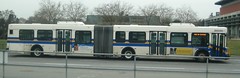
New Flyer D40LF, D60LF, C40LFR (some)


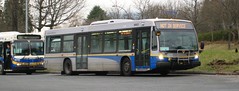
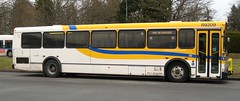
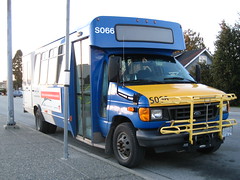
The D40LF and D60LF buses (top two photos) are most common for routes operating out of Burnaby, Surrey and Richmond (as well as C40LFR, bottom photo, out of the Tri-Cities). These are the most familiar to people because the layout is very simple.


In the drawing:
-seats labeled #1 and #2: flip them up!
-restraint belts located below seats labeled #2.
-therefore: vacate if you are in seats #1 or #2.

---

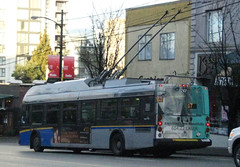
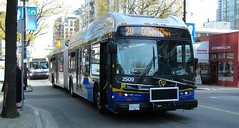
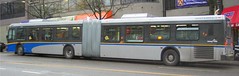
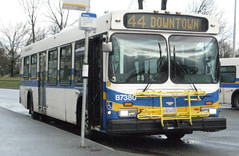
New Flyer E40LFR, E60LFR, D60LFR; Nova Bus


This is where some confusion occurs. The E40LFR and E60LFR buses (top 2 photos) are trolleys; the D60LFR buses are the new articulated buses (third photo from top); and the Nova Bus has the large front windows and wide front doors (bottom photo). The trick here is that the first wheelchair is behind the driver and faces backwards; the second wheelchair faces the front. Here is how it works.


In the drawing:
-seats labeled #1 and #2: if there is no wheelchair in this space, flip these seats up!
-first wheelchair parks at #1; #2 can be flipped back down if space allows it.
-seats labeled #3: if the spot at #1 is already occupied by a wheelchair, flip up all #3 seats.
-restraint belts are below the forward-facing #3 seats -- so all #3 seats MUST be vacated if a second wheelchair comes on!
-therefore: vacate if you are in seats #1; seats #2 may or may not need to be vacated (it depends on space).
-therefore: if #1 is already occupied, vacate seats #3.

---

Orion V


These buses run mostly from Bridgeport Station to Delta, White Rock and South Surrey. There are a few complications here: Orion V buses use lifts instead of ramps and they only have one door. However, the process here is quite straightforward.


In the drawing:
-#1 and #2 seats must be flipped up. Obviously, only one side is needed per wheelchair.
-restraints are below #1 seats and a lap belt is next to #2 seats.
-therefore: vacate #1 and #2 when needed.

---

Community shuttles


Community shuttles are kind of annoying. The only way for wheelchair users to enter is through a back door. In addition, it uses a lift that requires the driver to exit the vehicle to operate. Lastly, it requires straps and hooks that take forever to set up. Needless to say, these are not my favorite vehicles on the fleet. But nonetheless, they are still necessary.


In the drawing:
-flip up seats #1. These are finicky seats and the driver may need to assist.
-therefore: vacate seats #1.

---

Bus stops


In the drawing:
-accessible bus stops are marked with a wheelchair symbol.
-therefore: allow passengers with disabilities to board first. Simple.

---

SkyTrain: MK1


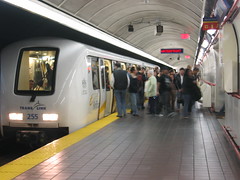
These SkyTrains are the old ones that first went into operation in the 1980s. They are often associated with the Expo Line but operate on both the Expo and Millennium Lines.


In the drawing:
-there are flip-up seats (#1 and #2) beside the doors. They should automatically flip up when you stand up.
-therefore: vacate seats at #1 or #2 when needed.

---

SkyTrain: MK2


These SkyTrains are the newer ones that went into operation in the late 1990s with similar ones coming in during the 2000s. They are often associated with the Millennium Line but operate on both the Expo and Millennium Lines.


In the drawing:
-flip-up seats are at #1 and #2. However, they are not immediately obvious; look for signs.
-#1 and #2 seats can be flipped up like bus seats.
-therefore: vacate seats #1 or #2 when needed.

---

SkyTrain: Canada Line


The Canada Line trains run exclusively on the Canada Line and have a more spacious inside layout. It is immediately obvious where the designated bike and wheelchair bays are.


In the drawing:
-wheelchair spots are at #1 and bicycle spots are at #2.
-therefore: vacate #1 when needed; #2 is often not needed for wheelchairs but it is still possible.

---

SkyTrain: doors


In the drawing:
-accessible seating is often located near doors with the wheelchair symbol.
-therefore: when boarding, be aware that passengers with disabilities are likely to use this door.

---

SeaBus


The Seabus connects downtown Vancouver to North Vancouver. There are no flip-up or movable seats to enhance accessibility, so things are a bit different here as well.


In the drawing:
-accessible seating #1 is often at the second door from the front or back of the ferry.
-the seating will always be next to the entrance or exit.
-therefore: if the space is needed, do not clog this area with luggage.


In the drawing:
-SeaBus doors have wheelchair symbols to indicate where the accessible spaces will be located.
therefore: when using these doors, be aware that there may be passengers with disabilities using the same doors to get on (and the same doors at the opposite end to get off).

---

Whew!

That is a lot to cover. I hope it was not overly detailed. So the next time you are wondering if you should vacate your seats or spots, there will be less confusion.

If you are still unsure, pay attention to what the passenger using the wheelchair or the driver is telling you. All of us want to get moving as efficiently as possible!

Wednesday, August 17, 2011

Strapped in and ready to rock

When taking a bus, one of the most interesting things that I notice is how others hook up or strap down their wheelchairs. It seems like everyone has their own method or preferred hooking up/strapping down method.


I apologize for the craptastic art.

The first thing to consider is that everyone's wheelchair is different. It's just like how people drive different cars. My wheelchair has things that others don't, and vice versa. I mentioned on Twitter how no two people load their wheelchair the same way – it's because everyone's chair and car are different.

Instead of seeking a single universal answer, it may be helpful to think about where is a "good" place to place the wheelchair restraints and where is a "bad" place to do it.


Handrims are stable hooking-up/strapping-in places... right?

When assisting, some drivers immediately try to use the restraints on the handrims or rear wheels of the wheelchair. This is a BAD idea.

There is the misconception that the wheel is a stable part on a wheelchair because, well, the whole reason the chair moves is because of the wheel! But for most rigid manual wheelchairs, the wheels can detach (part of the mechanism that makes it easier to store the chair). You don't want to be attaching a vital safety restraint on a removable part.

In addition, wheels can be damaged or bent due to force. I have heard of cases where using the wheel as a location for the restraints has resulted in a bent wheel, resulting in expensive repair costs. (I have Spinergy wheels on my chair and they routinely cost $600 a pair.)


The backrest should be an obvious place to strap down the chair... right?

Another seemingly obvious place to place the restraints is the backrest bar. After all, it's one of the closest areas to the restraint belts on a bus, right?

Well, it is the closest for sure. But I don't find that it is a safe place to strap down a wheelchair either. There are two big reasons why I don't think so.

The first reason is exclusively for rigid manual wheelchair users. Many rigid chairs cannot be folded down vertically (as in folding it down until the rear wheels are an inch apart from each other). Instead, they rely on the backrest folding DOWN on to the seat. As you can guess, since the backrest is a moving part, you don't want to be compromising its structural integrity by using it for a restraint belt.

My other reason has to do with safety and applies to all manual wheelchairs. Some people don't think of this, but wheelchairs can tip backwards. There are many methods to tip backwards (mostly to do "wheelies"). I tend to use my hips. But some others use their backs, which means – you guessed it! – putting force on the backrest. Imagine strong G-forces being applied on the backrest. It would be the ultimate wheelie, a.k.a. falling backwards and knocking your head on the ground.


Okay, how about using a non-moving part?

Another possible area to put the wheelchair restraint belts is on the axle area. This axle is also known as the "centre of gravity" bar. While it is movable, it requires strong tools to do so. I have great hand function and arm strength and believe me, you may need VERY strong tools and willpower to adjust it. Putting force on this axle will not cause the wheelchair user to tip backwards and it would take some extreme effort to make it move. This should be a good place to put the restraint belts, right?

I have never tried to use that bar, nor do I wish to. Why? Because I simply don't know if it would be damaged if the bus brakes and G-forces are applied to it. That bar is one of the most vital parts to a wheelchair that would be a complete nightmare to replace (and perhaps it might even be un-replaceable). I can't say it's a BAD idea to use it, but I can't say it's a GOOD idea either. It would be a huge risk to even test it, in my view. If anyone has input about this, please post in the comments; I'd appreciate it.


The method that is least risky to me and my chair.

My method is to choose a spot that is least likely to move, bend, or become damaged – the front bar, just above my casters. That bar doesn't look as secure as the other locations I mentioned, but for a titanium frame, it is least likely to bend. It will not move no matter what. It does not affect any moving parts. It is also easy to reach when getting off the bus. And it won't tip my chair over, which is a big plus. In short, it is nearly a foolproof place for the restraints.

Some drivers have expressed doubt over the security of this method. To the naked eye, it actually does look like a flimsy way to strap down a wheelchair. But this is the only method I've tried that has NEVER given me any problems. I've even been on a bus that had a collision before and this method passed the test. So when drivers look and ask, "Are you sure that's where you want the restraints?", I just look at them and say, "Definitely."

Do you have a preferred method of hooking up your wheelchair on a bus?

Saturday, May 14, 2011

Staying safe

One of the biggest challenges of being a wheelchair user is safety. Something as simple as navigating through a parking lot can be a challenge because if you have to cut through some parking spots, some people can't see you because people are shorter when seated. Same for crossing the streets -- some drivers' instincts are tuned towards people walking, not people rolling.

Similarly, staying safe on public transit is also a challenge for wheelchair users. However, there are some cases I've come across in the TransLink system where safety is not taken into account and could result in serious consequences.

One of the things that happen the most often is bus drivers taking off before passengers in wheelchairs are secured. My most recent incident was last week on the 99 B-Line. I boarded the bus, but the driver was more concerned about his schedule than safety. There was certainly not enough time for me to secure myself before the bus took off; in addition, one of the belts turned out to be broken, leaving me in a precarious situation for my trip. Through the whole trip, the driver was in a mad rush.

Now, I understand drivers needing to stick to a schedule but the potential consequences of an injury or incident due to disregarding safety would dwarf any problems you would have from simply being late. I'm lucky enough to have full hand and arm function but some wheelchair users do not and if they were in my situation, something would have likely happened and the driver would have been in big trouble.

Another common situation I find is on community shuttles. Some shuttle drivers don't use any straps or restraints for wheelchair users, which is apparently a big no-no. I actually did not know this until recently because a) I don't take shuttles often and b) no driver offered restraints or straps. But a few weeks ago when I went to the Vancouver Ability Expo in Yaletown, the shuttle driver took them out and started putting them on.

According to him, shuttle drivers are required to use the straps and restraints. For both trips using shuttles that day, the restraints were used. They take slightly longer than belts and straps on a regular bus but for me, the delay was not by much at all. I wonder how much time was actually "saved" on my previous strapless and restraintless trips.

I don't know if this is a thing going on with the South Surrey shuttles (which my previous trips were on) or if the Vancouver shuttles are more strict about safety. But South Surrey and White Rock shuttle routes are a lot steeper and turbulent, and probably need the restraints more than the Vancouver shuttle routes I've taken.

In a way, I'm surprised more incidents haven't occurred. But I guess if I had an incident happen to me, I'd be hesitant or scared to take transit again. It makes me wonder how many have been scared off conventional transit as a result. So much for integrating people with disabilities into society.